

This is the complete guide to cable guided outdoor blinds in Malaysia.
If you’ve been dealing with rain-soaked furniture, blinds that flap apart in the wind, or a balcony that’s too hot to use for half the day, this guide will show you exactly how to fix all three.
Permanently.
We’ll cover how the system works, which materials actually survive our climate, where cable guided blinds fit (from condo balconies to restaurant terraces), and the practical tips that separate a great installation from one you’ll regret.
Let’s dive in.
Contents
- Chapter 1: How cable guided outdoor blinds work
- Chapter 2: Built for Malaysia’s climate
- Chapter 3: Choosing the right materials
- Chapter 4: Cable guided blinds for every home
- Chapter 5: Cable guided blinds for restaurants and cafes
- Chapter 6: Motorization and smart controls
- Chapter 7: Buying, installing, and maintaining
Chapter 1: How cable guided outdoor blinds work
If you’ve ever watched a standard outdoor blind flap violently in the wind and rip itself off the bracket, you already know the problem.
In this chapter, you’ll learn exactly how cable guided systems work, what makes them different, and why they outperform every other outdoor blind option in Malaysia.
What are cable guided outdoor blinds?
Cable guided outdoor blinds are weather-resistant roller blinds that run along two vertical stainless steel cables. One on each side.
The cables keep the blind tracking straight and flat as it rolls up and down.
No swaying. No flapping. No lateral movement.
In short: they’re outdoor roller blinds that actually stay put in real weather.
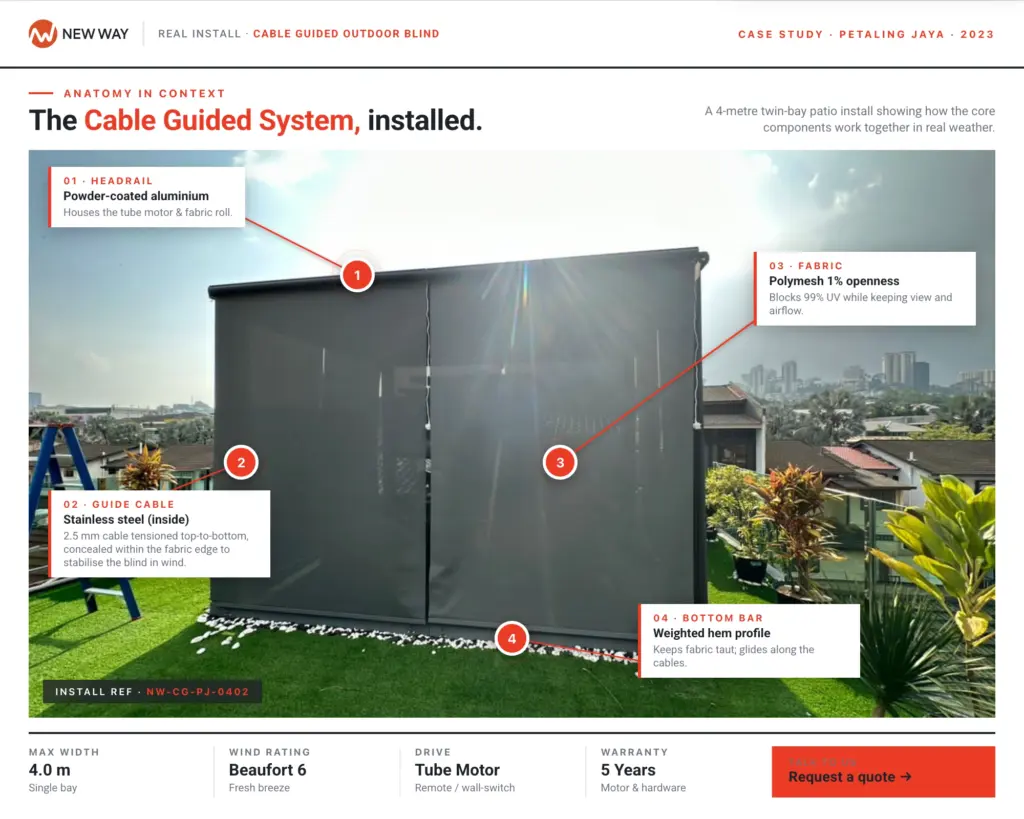
Two tensioned cables are anchored at the top and bottom of your opening. The blind’s bottom bar has guides that clip onto these cables. As the blind rolls down, the bar slides along the cables. As it rolls up, the bar rides them back to the top.
That’s it. Two cables. One bottom bar with guides. Problem solved.
The rest of the system works like any outdoor roller blind. The fabric rolls around a tube housed in a headrail at the top. You operate it with a manual cord loop or a tubular motor.
The only difference? How the blind moves: guided, not free-floating.
And that one difference is what separates a blind that works on calm days from one that works in a monsoon.
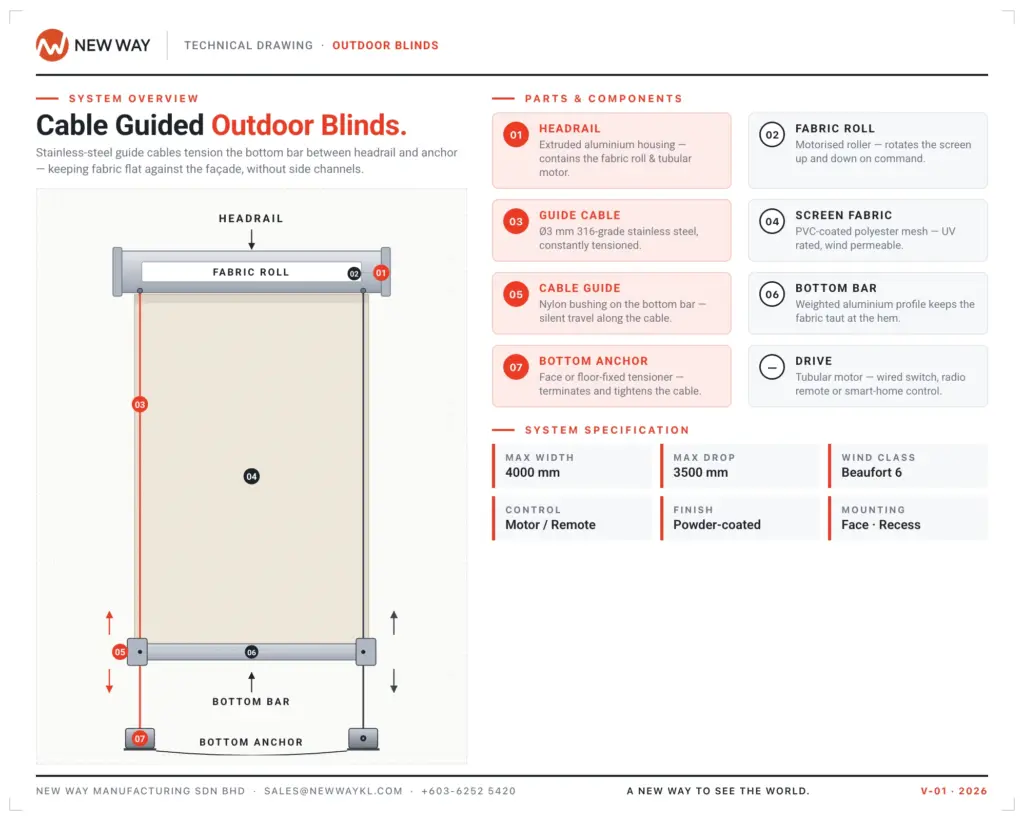
The key components of a cable guided system
Understanding the parts helps you spot quality. And avoid junk.
The cables. Quality systems use 316 marine-grade stainless steel with a nylon coating.
The system does two jobs. It protects the steel from salt and UV. And it lets the bottom bar glide along the cable in smooth, quiet motion.
Cheaper systems corrode within 1 to 3 years. (Chapter 3 covers why the grade matters.)
The bottom bar. A weighted aluminum bar that keeps the fabric taut. Heavier bars handle wider blinds better.
The headrail. Exposed roll or cassette (enclosed housing). Cassette headrails look cleaner and protect the fabric when retracted.
The fabric. Most systems use PVC-coated polyester (30/70 blend). Waterproof, flame retardant, UV resistant, and easy to clean.
The fabric faces the weather every single day. Its composition matters more than most people realize.
The roller tube. Standard tubes work for most blinds. Wider installations need upgraded tubes to prevent bowing. (Chapter 3 covers exact sizing.)
How cable guided blinds compare to every other system
Not all outdoor blinds are the same. Here’s how cable guided stacks up.
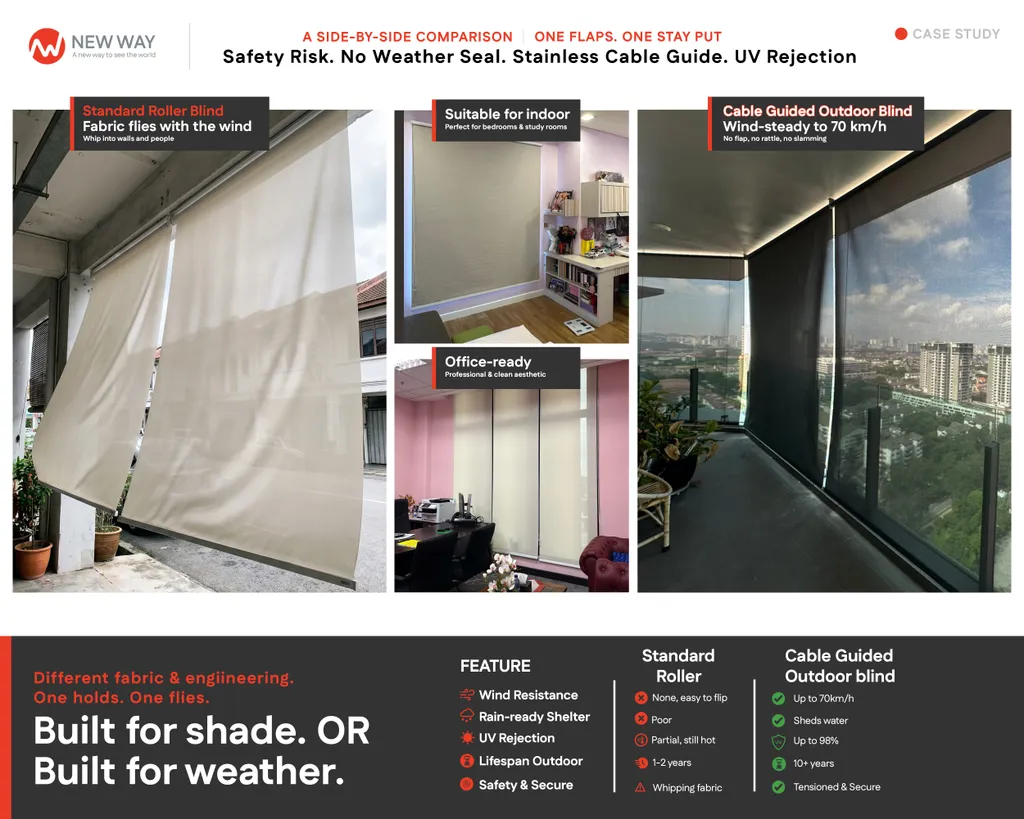
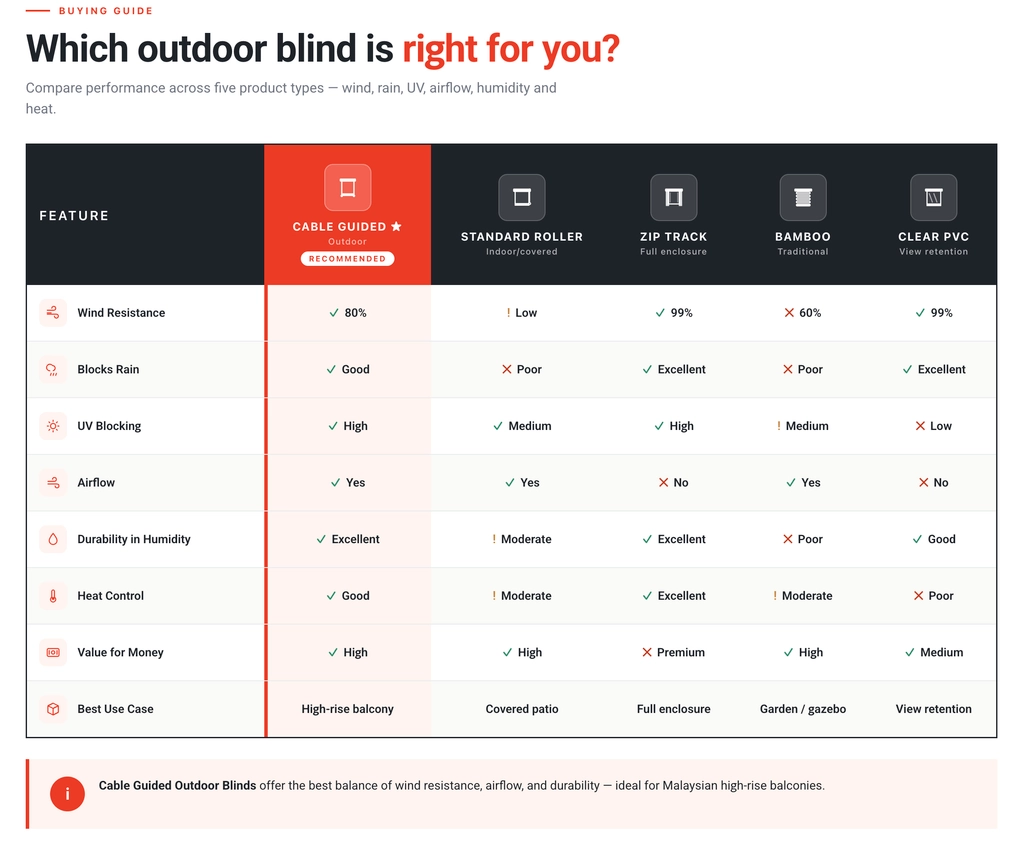
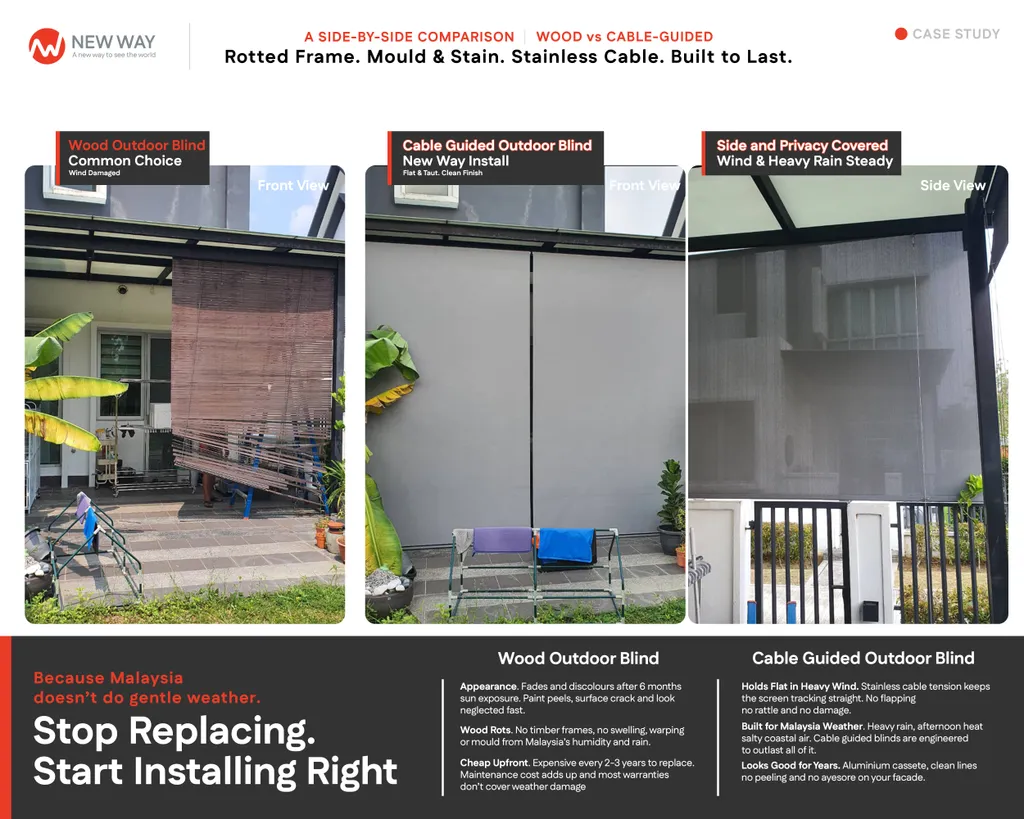
Cable guided vs. standard roller blinds. Standard blinds have no guiding mechanism. The bottom bar hangs free. Wind causes swaying, gaps, and accelerated wear. Cable guided eliminates all of this.
The performance gap isn’t small. It’s the difference between a system that works in real weather and one that only works on still days.
Cable guided vs. zip track blinds. Zip track seals the fabric into aluminum channels. Near-complete seal. But more expensive and less forgiving of structural irregularities. For most Malaysian homes, cable guided delivers 90% to 95% of zip track’s performance at a lower investment.
Cable guided vs. bamboo. Bamboo looks beautiful but absorbs moisture, warps, and degrades within 2 to 4 years in Malaysia’s humidity. Use bamboo decoratively. Install cable guided for weather protection.
Cable guided vs. clear PVC. Clear PVC traps heat aggressively, yellows within 3 to 5 years, and develops condensation. Cable guided with translucent fabric offers better balance.
Why cable guided is the system most specialists recommend
Three reasons. They handle both wind and rain simultaneously. They work across a wide range of installations. And they offer the best balance of performance and value.
Cable guided sits in the sweet spot.
Pro tip: If a supplier pushes standard roller blinds for an exposed balcony, push back. The investment difference is small. The performance difference is enormous.
Chapter 2: Built for Malaysia’s climate
Malaysia’s weather is the reason most outdoor blinds fail within a year. In this chapter, we break down every climate challenge and show you how cable guided handles each one. With numbers.
How cable guided blinds handle Malaysia’s monsoon rain
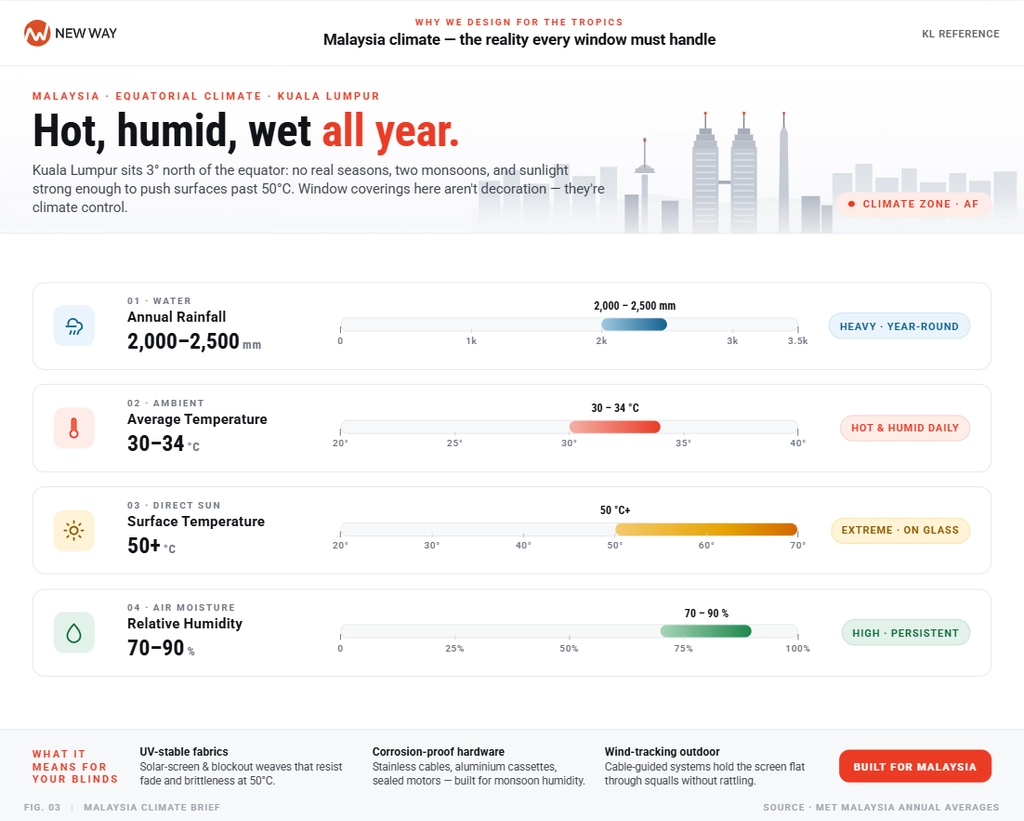
Malaysia receives 2,000-2,500mm of rainfall annually. Among the HIGHEST in Southeast Asia. Sudden storms can dump 50mm in under an hour.
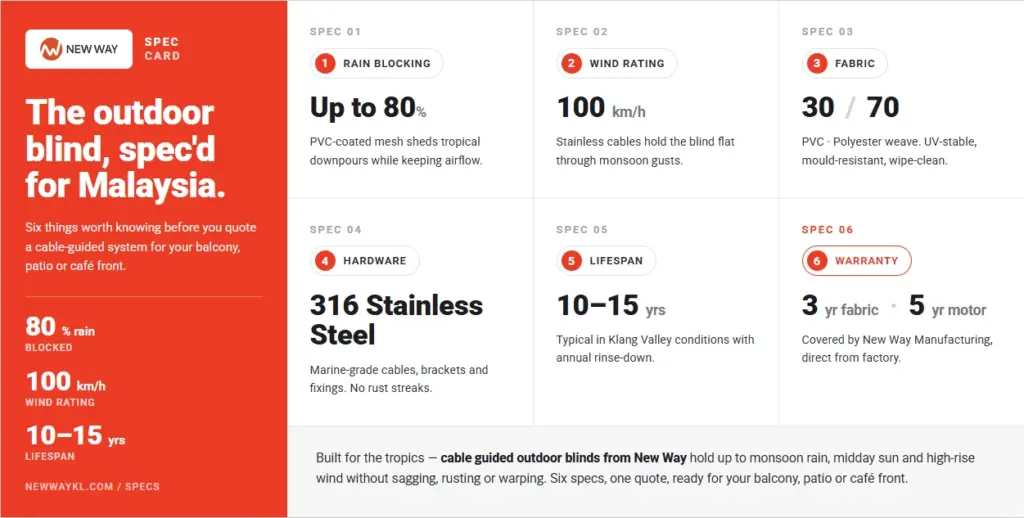
Cable guided blinds use PVC-coated polyester. Water beads on the surface and runs off. A properly installed system blocks up to 80% of rainfall.
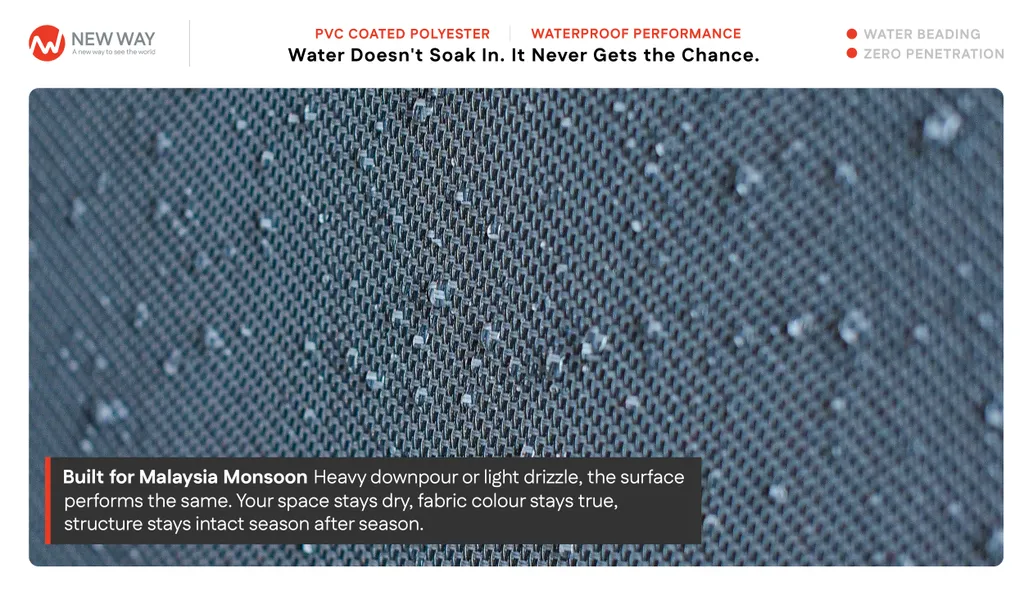
Why not 100%? Small gaps at the cable guides. (For most homeowners, 80% is MORE than enough. For near-complete sealing, upgrade to zip track.)
Why the cable system survives monsoon winds
During monsoon season, sustained winds of 25 to 40km/h with gusts exceeding 60km/h. Standard blinds flap, tear, and fail. Cable guided blinds eliminate all of this. The fabric stays taut. The bar stays locked. The blind stays quiet.
Why this matters even more on higher floors
Condos on level 10+ experience SIGNIFICANTLY stronger winds. A standard blind at that height is disposable. A cable guided system lasts a decade.
(We’ve installed systems on balconies up to level 35. Wind has never been the reason for a replacement.)
How cable guided blinds fight Malaysia’s heat and UV
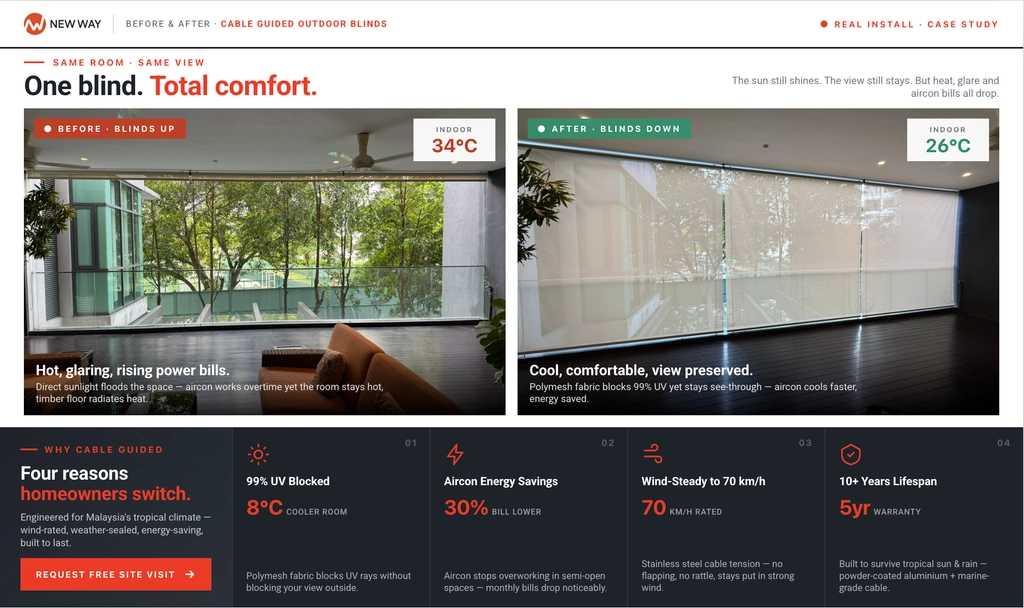
An unshaded balcony in KL is unusable between 11am and 4pm. Cable guided blinds block solar radiation BEFORE it reaches your space. Temperature drops by 10°C to 15°C. Less heat entering = lower electricity bills.
UV: the silent destroyer
Without protection, outdoor furniture degrades within a single season. PVC-coated fabric filters UVA and UVB while allowing natural light through. The neighbor replaces their patio set every 2 to 3 years. You’re still using the same set after 5.
Pro tip: UV-filtering blinds reduce sun exposure for children and elderly family on the balcony. In a near-equatorial country, that matters.
Insects, dust, and debris
Ask any Malaysian homeowner what ACTUALLY annoys them most: mosquitoes, dust, and leaves. Cable guided blinds act as a physical screen. One less sweep per day = 365 fewer sweeps per year.
Humidity and mold
Malaysia’s 70-90% humidity creates perfect mold conditions. PVC-coated fabric is non-porous and mold-resistant. The right stainless steel grade resists corrosion. (Chapter 3 covers which grade to insist on.)
In Malaysia’s climate, the material isn’t a nice-to-have. It’s the whole game.
Chapter 3: Choosing the right materials
The fabric and hardware determine whether your system lasts 3 years or 10+. This chapter covers every material decision.
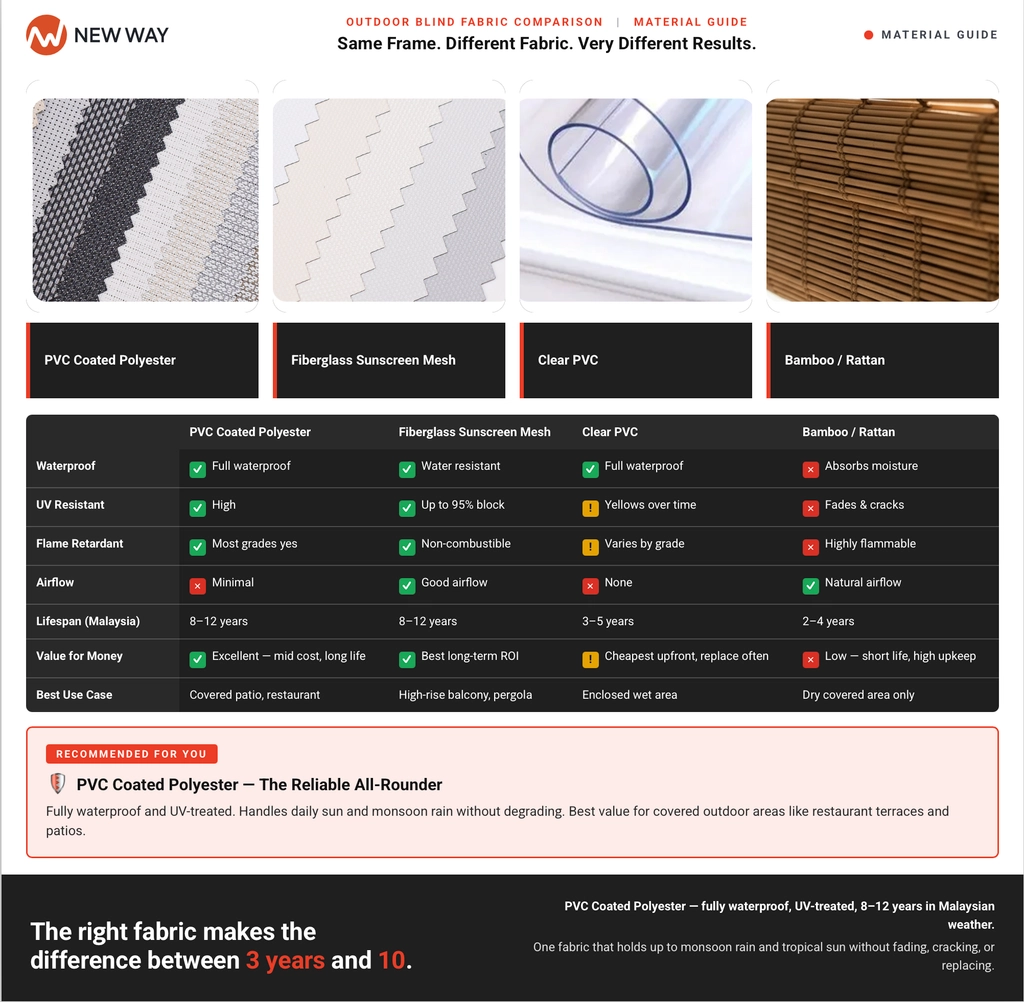
PVC-coated polyester: the cost-effective standard
30% polyester, 70% PVC. Waterproof, UV resistant, flame retardant, easy to clean. Lifespan: 10 to 15 years. For most installations, this is the right starting point. Full stop.
The spec that matters most: openness factor
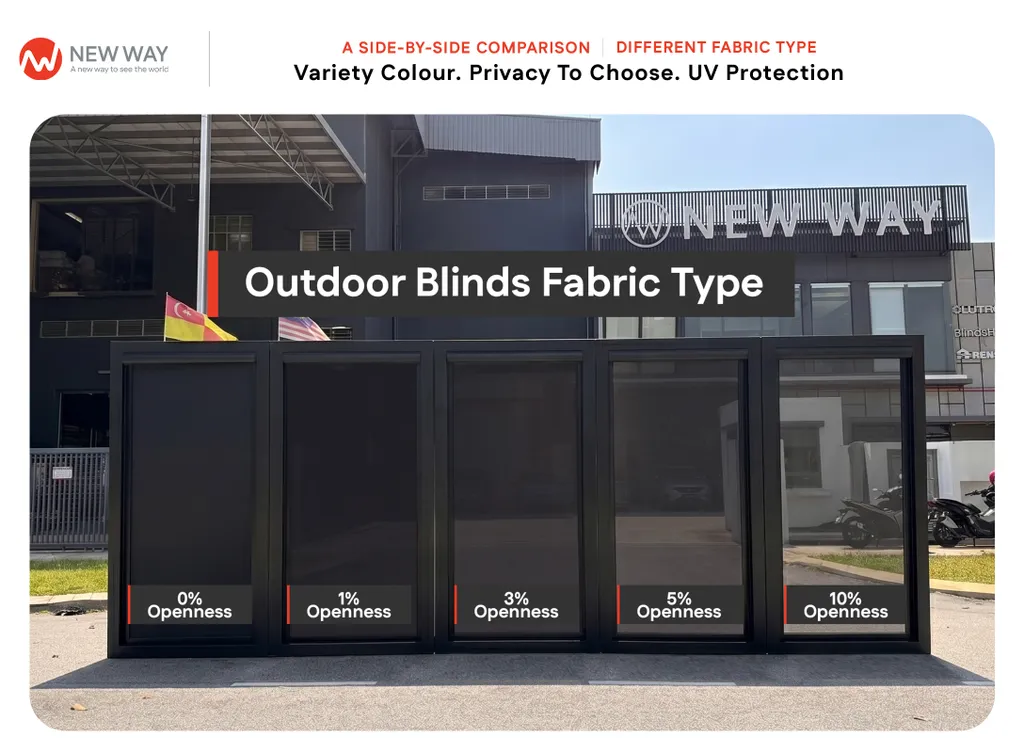
The single most important number when choosing fabric. A 1% openness factor blocks SIGNIFICANTLY more heat and rain than 5%. We recommend 1% to 3% openness for most Malaysian homes.
Pro tip: If a supplier can’t tell you the openness factor, that’s a red flag.
Fiberglass fabric: the premium upgrade
Better view-through at the same openness factor. Superior dimensional stability (doesn’t stretch or shrink with heat). Greater durability. More expensive. For most installations, polyester is enough. But fiberglass is a genuine upgrade if budget allows.
Clear PVC and bamboo: know the trade-offs
Clear PVC traps heat, yellows in 3-5 years. Bamboo degrades in 2-4 years in Malaysia’s humidity. Stick with PVC-coated polyester or fiberglass.
316 stainless steel: why the hardware grade is non-negotiable
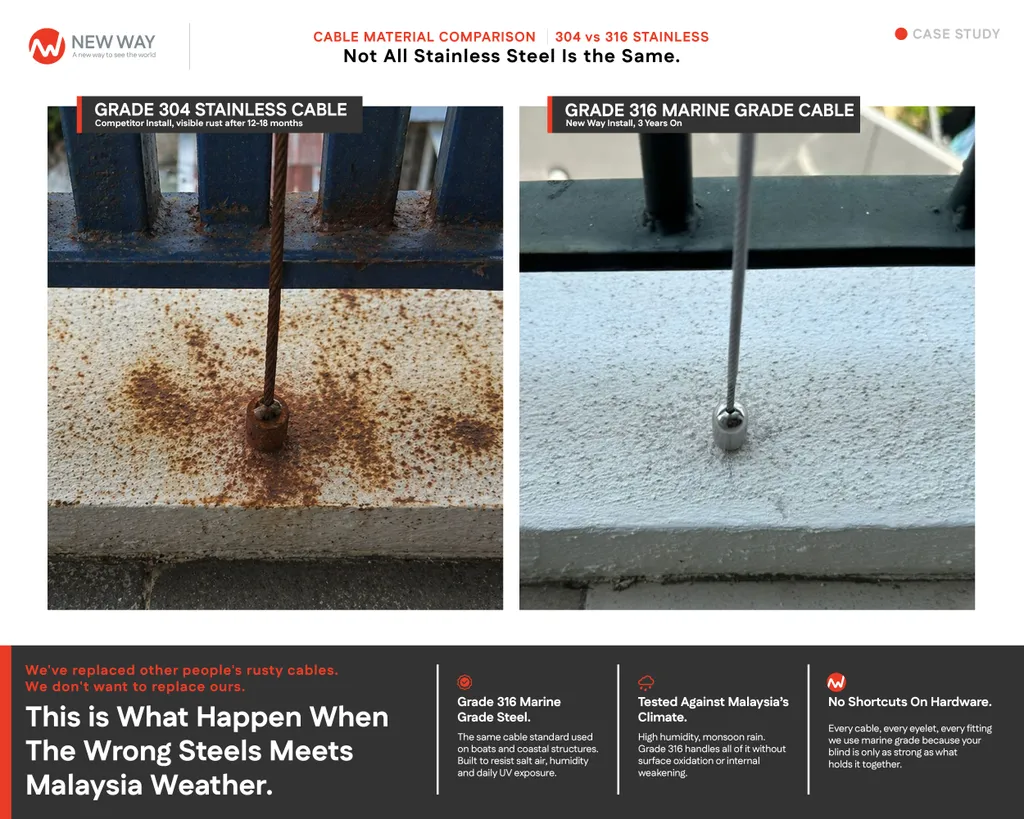
316 is marine-grade. 304 looks IDENTICAL but pits and rusts within 2-3 years. If they can’t tell you the grade? Red flag. We’ve seen 304 fail within 18 months in coastal homes.
Roller tube sizing
50mm standard for blinds up to 3m. Over 3m, upgrade to 65mm or 80mm. If your installer doesn’t mention this for a wide blind, ask.
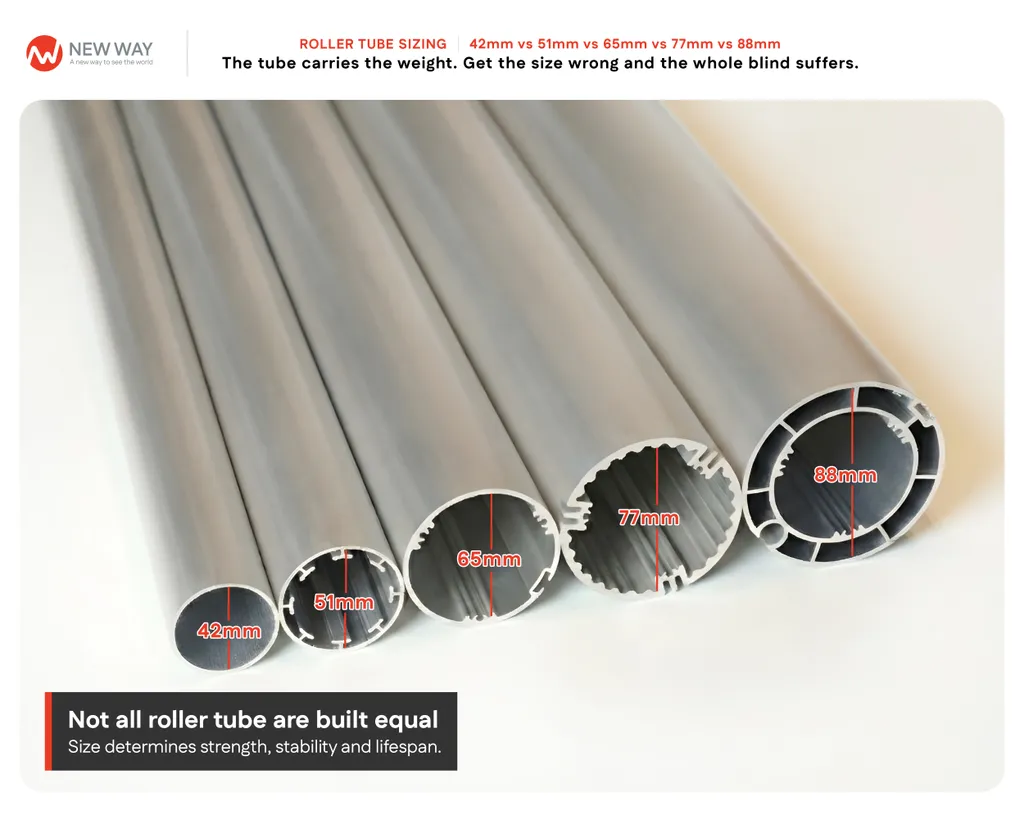
The material cheat sheet
Fabric: PVC polyester, 1-3% openness (upgrade to fiberglass if budget allows). Hardware: 316 stainless steel, no exceptions. Tube: 50mm up to 3m, 65/80mm wider. Bottom bar: Standard up to 3m, heavy-duty over 3.5m. Headrail: Cassette if budget allows.
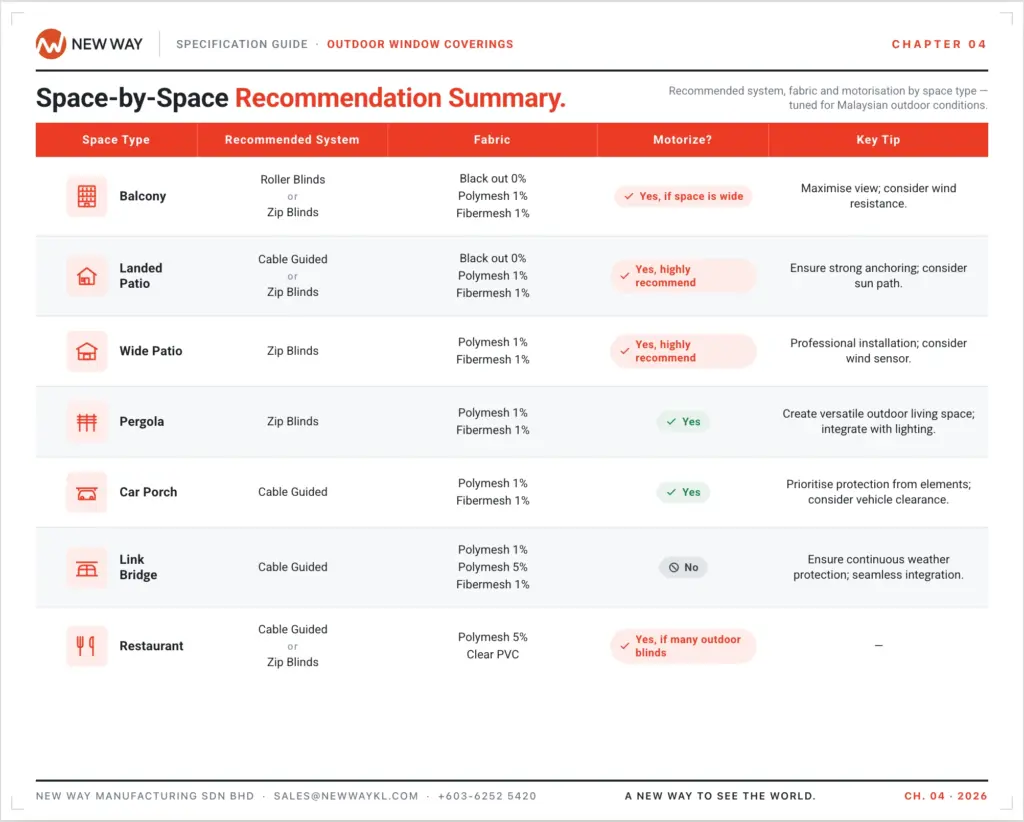
Chapter 4: Cable guided blinds for every home
Condominium and apartment balconies
Most common installation. Check wind exposure, space, and building management approval. Recommended: Cable guided with 1-3% openness PVC and cassette headrail.
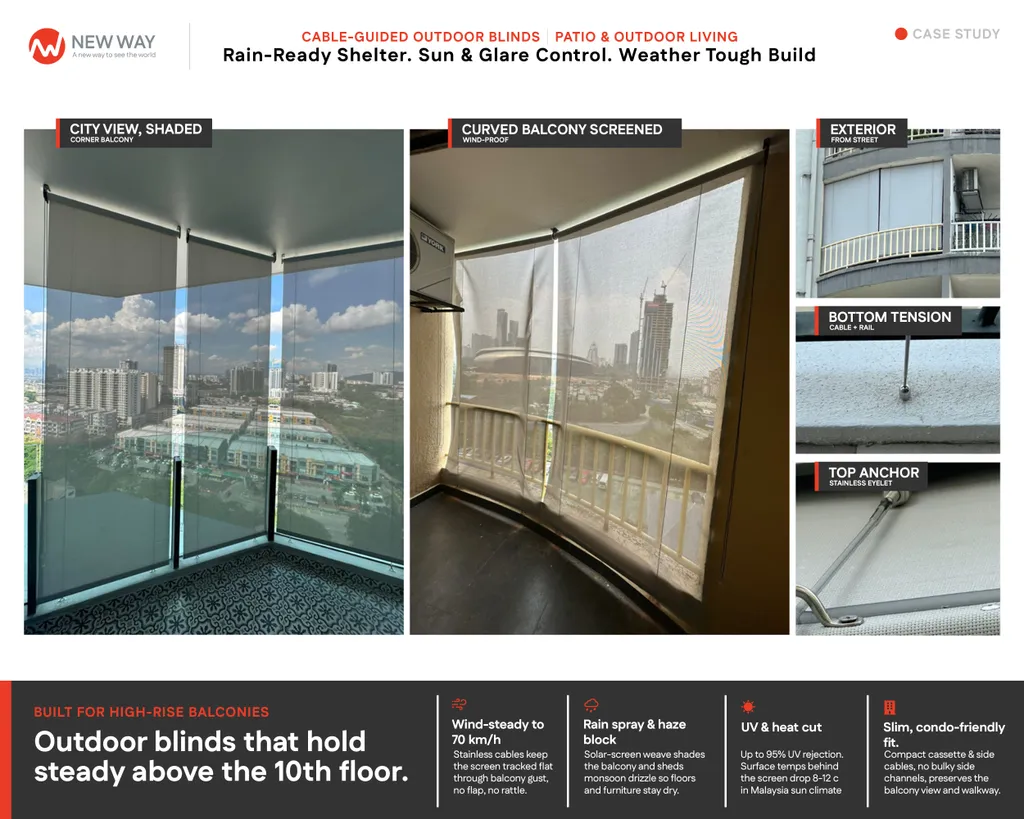
Cable guided: the most cost-effective outdoor blind for high-rise living
Not the only option, but the most cost-effective one. Want 99% rain blocking? Upgrade to zip track. Our recommendation: start with cable guided. Upgrade to zip if you need that last 10%.
Landed property patios and terraces
Wider spans need stronger tubes, heavy-duty bars, and often motorization. For 6-8m openings: multiple blinds side by side.
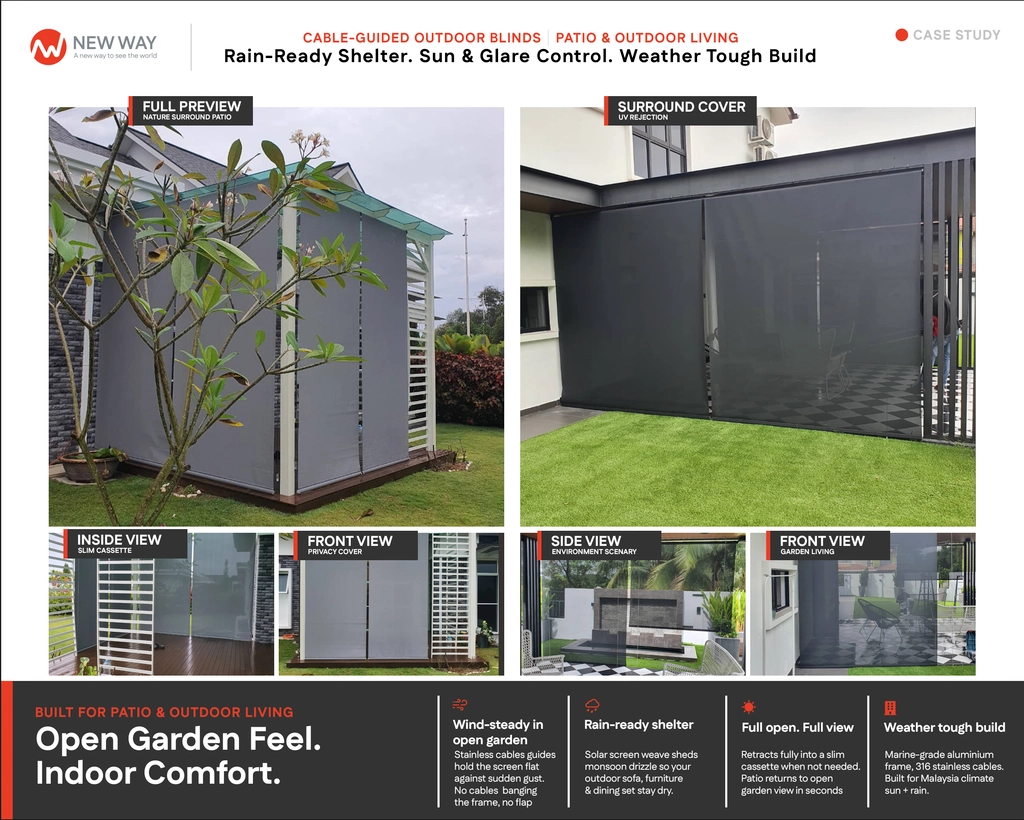
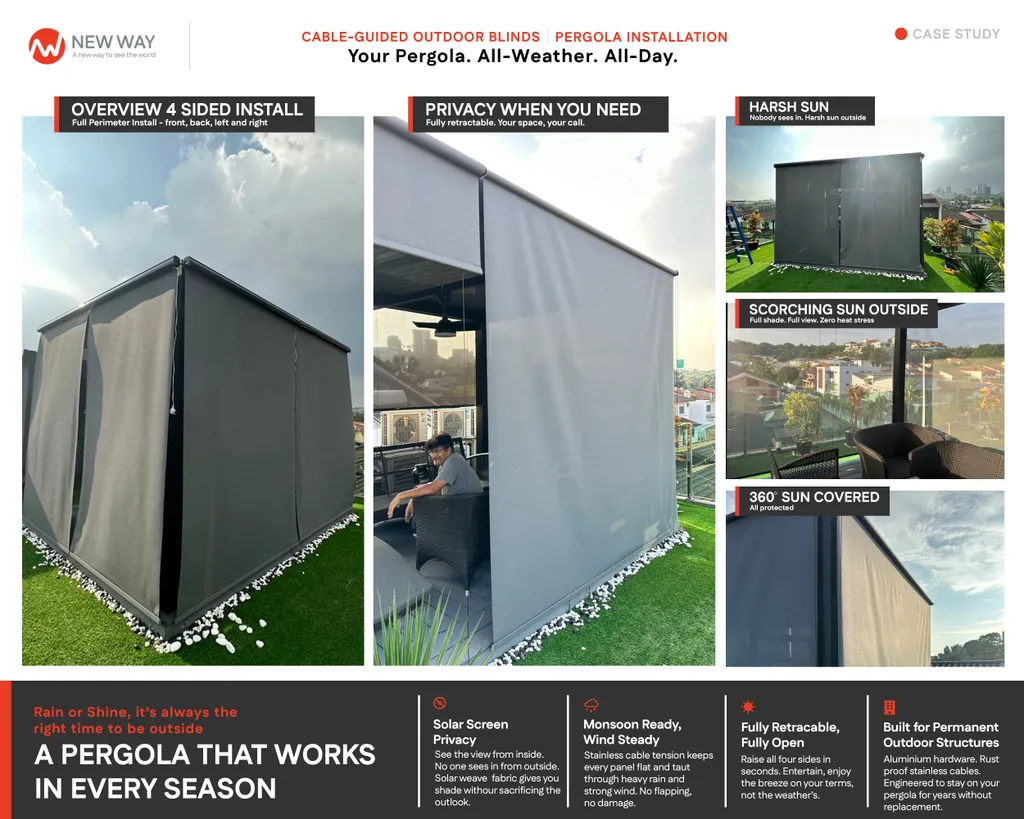
Pergolas and garden structures
Cover weather-facing sides only. Leave sheltered sides open for airflow.
Car porches, driveways, and link bridges
Car porches: UV protection and shaded space. Link bridges: watch for the tunnel effect.
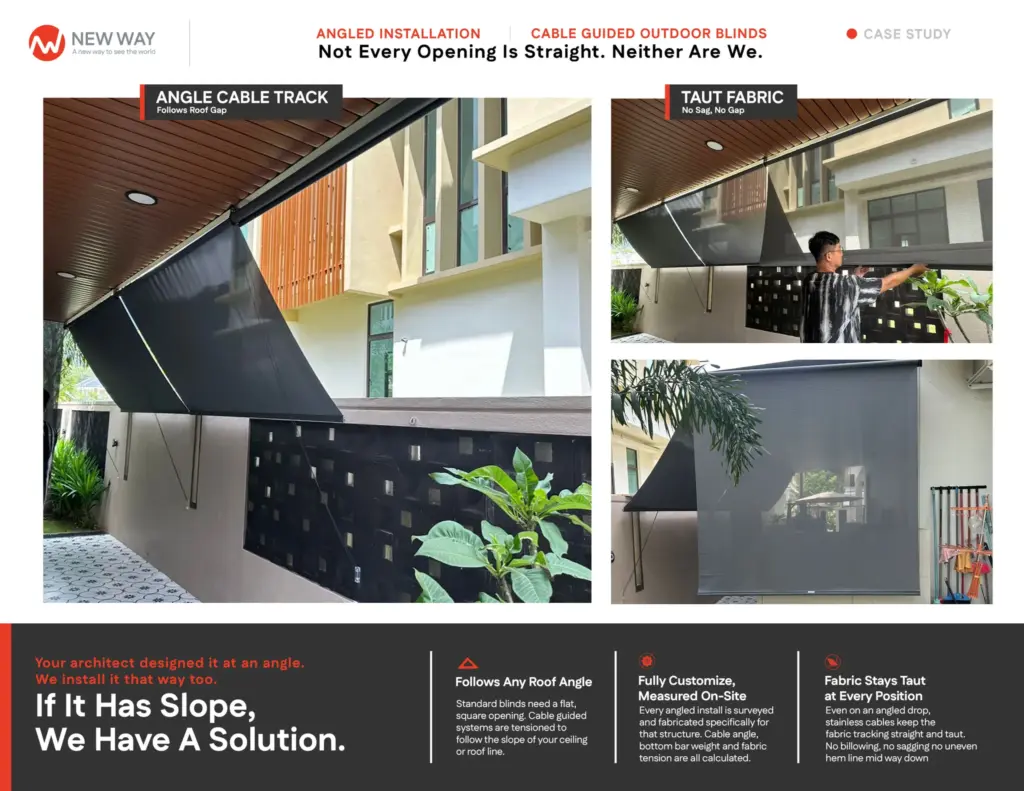
Angled and sloped outdoor windows
Raked balconies, sloped pergola sides, angled feature walls. Cable guided handles up to 20 degrees off vertical.
Chapter 5: Cable guided blinds for restaurants and cafes
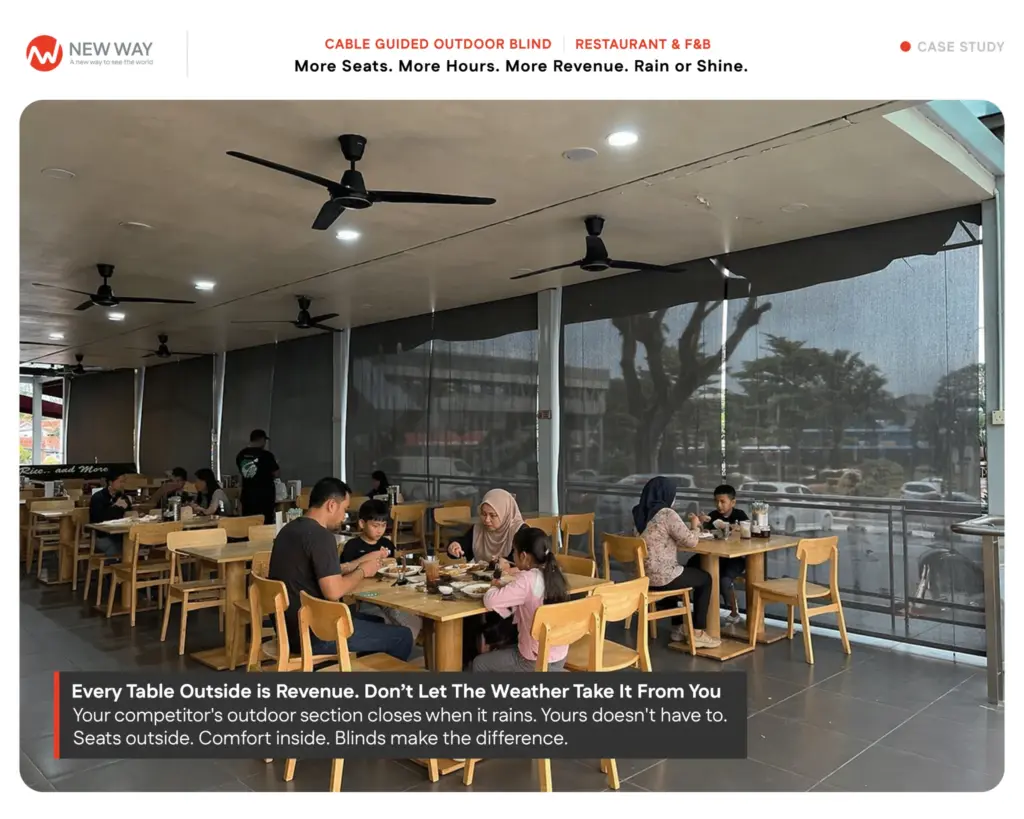
Every empty outdoor table is lost revenue. Cable guided blinds reclaim 30-50% of outdoor capacity.
The revenue problem
Without outdoor blinds, most Malaysian restaurants lose 30% to 50% of outdoor seating capacity to weather.
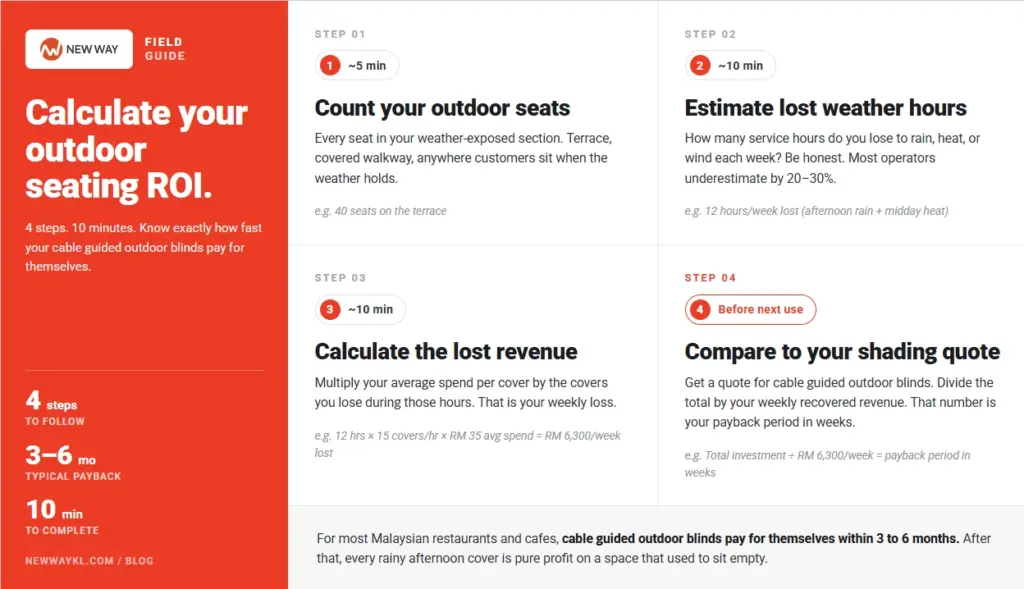
Think about your own terrace. How many hours did you lose last week?
Multiply that by your average spend per cover. That’s revenue sitting on the table.
Controlled atmosphere and branding
16+ color options. Custom printing available. Flexibility that permanent walls can’t offer.
Fire safety
PVC-coated polyester is flame retardant. Fire certification is the operator’s responsibility. Confirm before installation.
Cable guided vs. zip track for commercial
Cable guided for most terraces. Zip track when you need complete sealing.
Chapter 6: Motorization and smart controls
Manual works fine. Until it doesn’t. This chapter covers when to upgrade and what to choose.
How motorization works
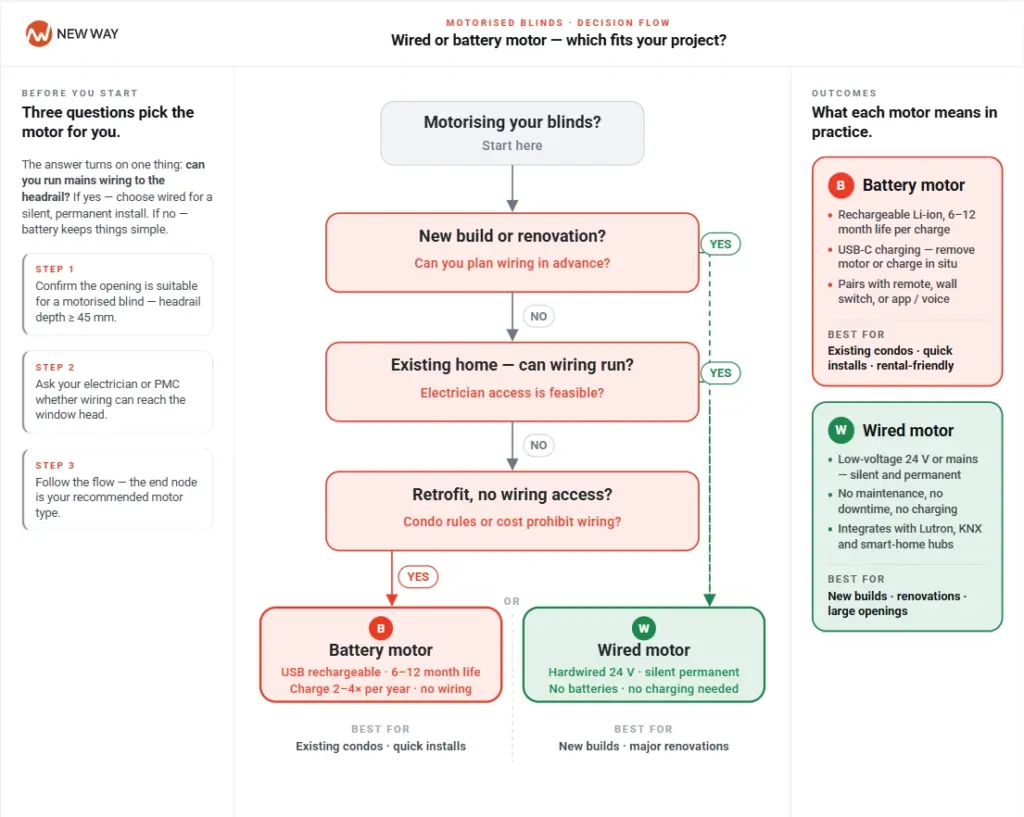
Tubular motor inside the roller tube. Under 40 decibels. Quiet.
Why rechargeable motors don’t work for outdoor blinds
Outdoor blinds are HEAVY. Battery drains in weeks, not months. Hardwired is the only practical choice.
Planning your wiring
New build? Wire during construction. Retrofit? Run through existing conduit. Wiring impossible? Stay manual.
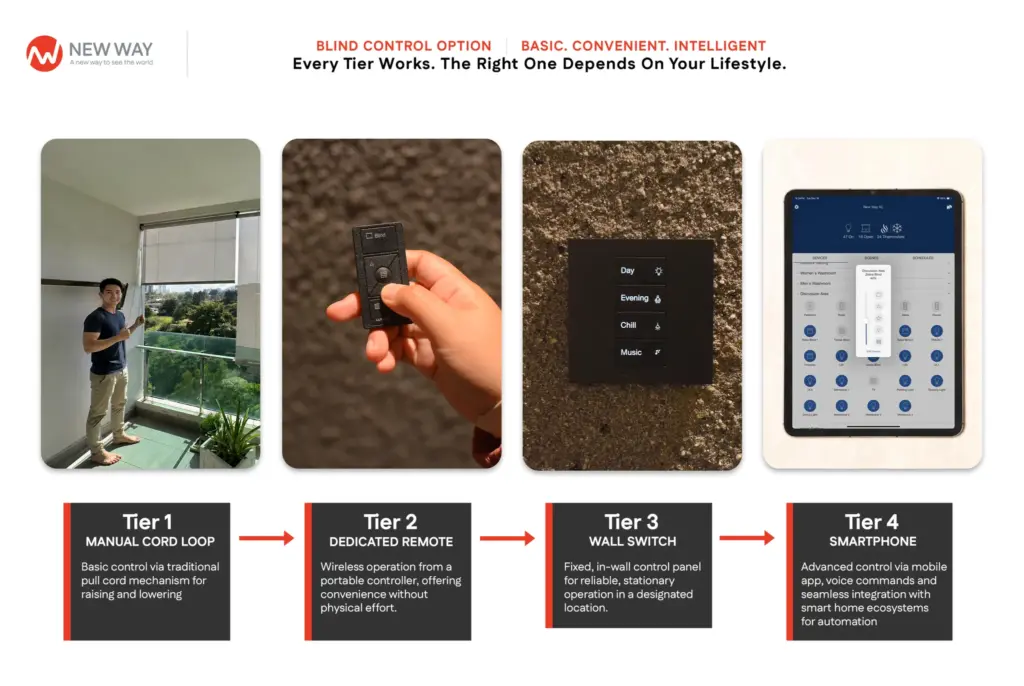
Control options
Remote, wall switch, WiFi smart control. Compatible with Google Home, Alexa, HomeKit. “Hey Google, lower the patio blinds.”
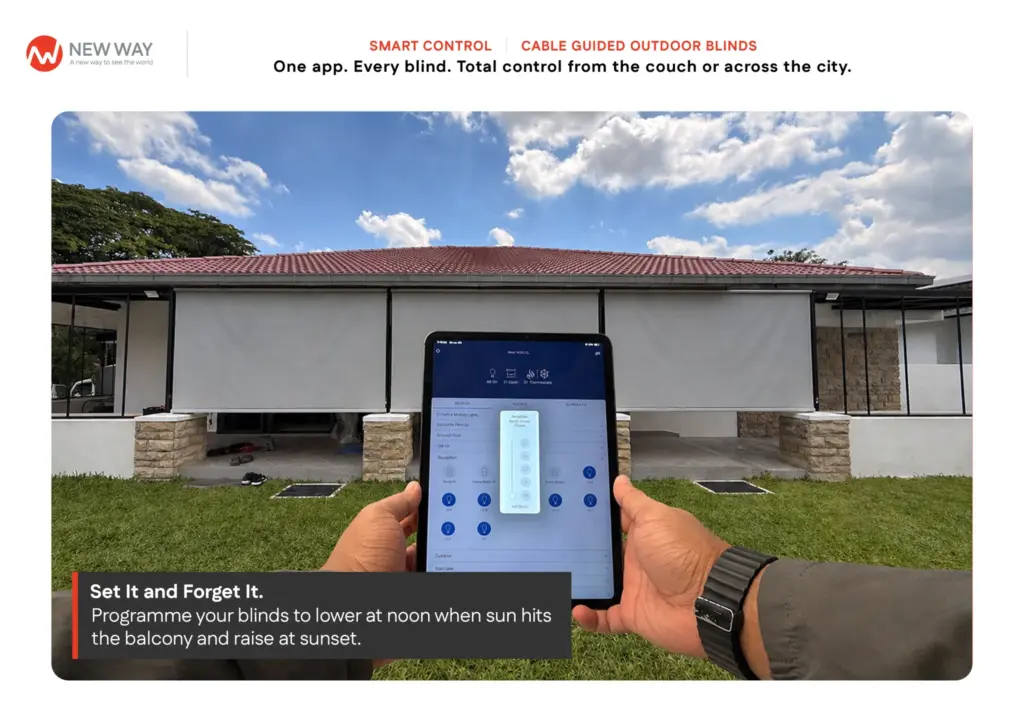
Rain and wind sensors
Our FAVORITE feature. Blinds respond to weather automatically. Protection on autopilot.
When to motorize vs. stay manual
Over 3m wide: motorize. Under 3m: manual is fine. Tight budget? Spend on fabric and hardware first.
Future-proofing
Ask for motor-compatible hardware from the start. Costs almost nothing now. Saves thousands later.
Motor warranty
5-year motor warranty. 10,000+ cycles (14 years of daily use).
Chapter 7: Buying, installing, and maintaining
Practical tips from years of real installations across Malaysia.
Tip 1: Measure twice, order once
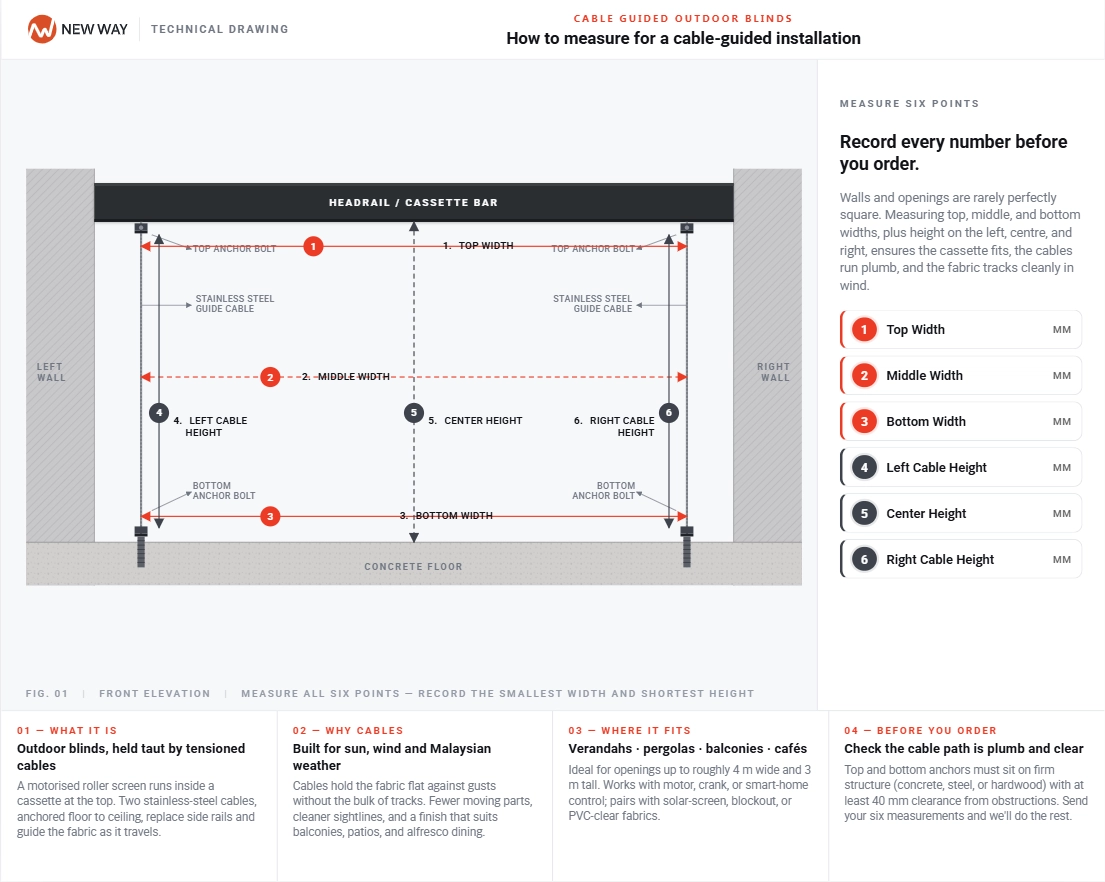
Six measurements: width at 3 points, height at 3 points. Openings are rarely square.
Cables are cut to length on site, not pre-cut at the factory. Another reason precise measurements matter.
Tip 2: Know what cable guided won’t pair with
Side channels won’t fit. The cable guides on the bottom bar use the same side space aluminum channels need. Pick one or the other, not both.
If you want channel-locked, near-complete sealing, that’s zip track territory.
Tip 3: Choose fabric color strategically
Lighter = cooler, brighter. Darker = more heat blocking, more privacy. Mid-tone grey or charcoal is the sweet spot for most Malaysian homes.
Tip 4: Don’t skip the site survey
Be wary of any supplier who quotes from photos alone. Good suppliers do free site surveys.
Tip 5: Ask the right warranty questions
What’s excluded? What’s the claim process? What’s the response time?
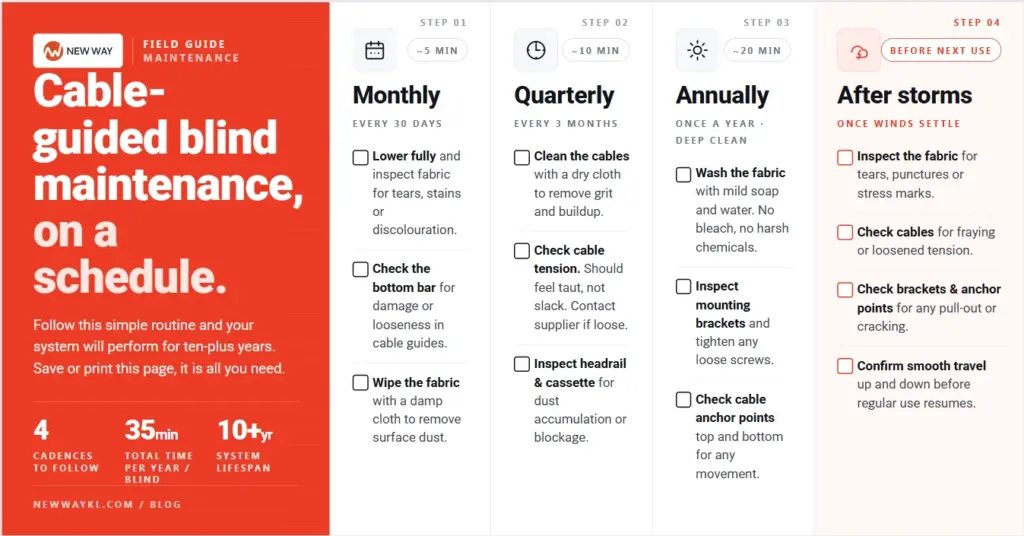
Tip 6: Maintain for maximum lifespan
Monthly: inspect and wipe. Quarterly: clean cables. Annually: wash fabric. After storms: damage check.
Tip 7: Know when to retract
Retract above 80km/h winds. Normal monsoon weather? That’s what cable guided is built for.
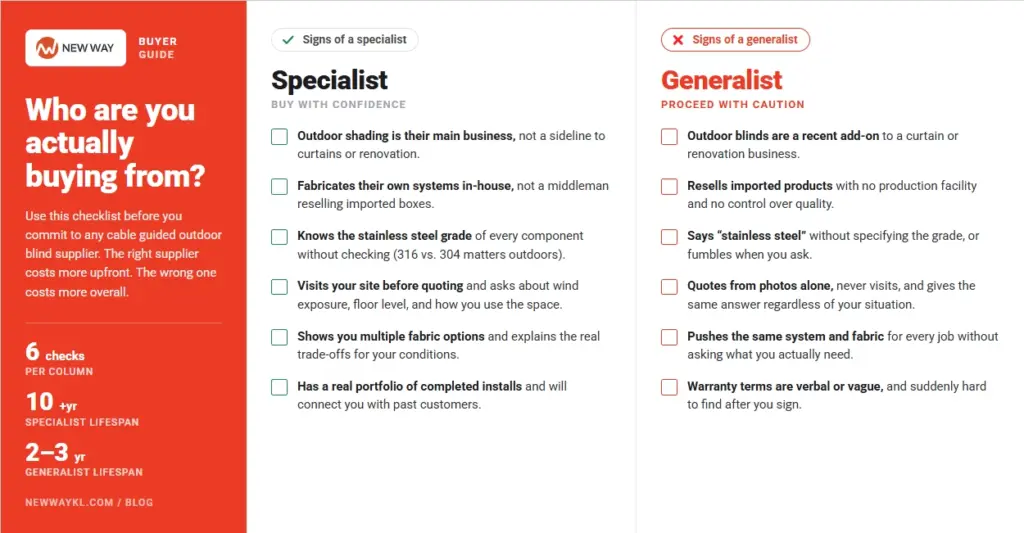
Tip 8: Work with specialists, not generalists
A specialist installation lasts 10-15 years. A generalist installation often fails within 2-3 years.
Ready to transform your outdoor space?
Start here: identify your space (Ch4/Ch5), confirm materials (Ch3), request a site survey.
What drove you to start researching cable guided blinds? Drop a comment below.
Cluster 1: Decision & Comparison
Are cable guided outdoor blinds better than zip track blinds?
Cable guided outdoor blinds deliver 90-95% of zip track performance at a lower investment, making them the right choice for most Malaysian homeowners. The difference is edge sealing: zip track systems lock fabric into aluminum side channels for near-complete weatherproofing, while cable guided systems use tensioned stainless steel cables that stabilize the blind without a full perimeter seal.
For most residential balconies and patios, this performance gap does not justify the price difference. Choose zip track when you need a sealed outdoor room or a commercial space operating through heavy monsoon rain. Cable guided is the better starting point for most homes.
Can cable guided outdoor blinds handle strong monsoon winds?
Yes. Cable guided outdoor blinds are engineered for Malaysia’s monsoon conditions, which bring sustained winds of 25-40km/h and gusts exceeding 60km/h. Two tensioned 316 marine-grade stainless steel cables anchor the blind’s bottom bar, eliminating the lateral sway and fabric flapping that unguided roller blinds develop in wind.
The recommended practice is to retract the system when winds exceed 80km/h. Below that threshold, the cable tension holds the fabric flat, stable, and sealed against the opening. Standard roller blinds without a guiding mechanism are not designed to perform in these conditions.
What is the difference between cable guided and standard outdoor roller blinds?
Cable guided outdoor blinds differ from standard outdoor roller blinds in one critical way: the guiding mechanism. Standard outdoor blinds hang freely at the bottom bar, which allows the fabric to sway, gap, and wear in wind. Cable guided systems run the bottom bar along two tensioned stainless steel cables, keeping the blind flat regardless of wind direction or speed.
As of 2026, standard roller blinds remain common for sheltered outdoor areas with minimal wind exposure. For exposed balconies, patios, or any opening where monsoon rain and wind are regular, cable guided is the minimum recommended system.
Cluster 2: Technical Specifications
How much rain do cable guided outdoor blinds actually block?
A properly installed cable guided outdoor blind system blocks up to 80% of rainfall. Rain enters through the gap between the fabric edge and the surrounding structure, since the cable guides do not create a sealed channel the way zip track systems do.
In practice, 80% rain blocking keeps outdoor furniture usable through light to moderate rain and protects against wind-driven spray. For near-complete sealing (99% blockage), upgrade to zip track. For most Malaysian home balconies and patios, cable guided delivers sufficient protection at a more accessible price point.
What fabric should I choose for cable guided outdoor blinds in Malaysia?
For cable guided outdoor blinds in Malaysia, PVC-coated polyester (30% polyester, 70% PVC) is the standard specification. It is waterproof, UV resistant, flame retardant, easy to clean, and carries a 10-15 year operational lifespan in Malaysia’s humidity.
As of 2026, a 1-3% openness factor is the recommended specification for most Malaysian homes. It blocks significantly more heat and rain than a 5% fabric while still allowing air movement. For better view-through at the same openness level, fiberglass fabric is the premium alternative. Bamboo and clear PVC degrade within 2-4 years in Malaysian conditions and are not recommended.
What motor warranty do motorized cable guided outdoor blinds come with?
Motorized cable guided outdoor blinds include a 5-year motor warranty. The tubular motor operates at under 40 decibels and is rated for 10,000+ open/close cycles, the equivalent of approximately 14 years of daily use.
The motor sits inside the roller tube and requires a dedicated wired power supply. Rechargeable motors are not suitable for outdoor applications due to limited cycle life and weather exposure. For cable guided blinds wider than 3 meters, motorization is the recommended control method rather than a manual chain, which becomes difficult to operate at larger widths.
Cluster 3: Trust & Risk
How long do cable guided outdoor blinds last?
A professionally installed cable guided outdoor blind system lasts 10-15 years. Hardware grade is the primary variable. The cables and fittings must be 316 marine-grade stainless steel: grade 304 steel pits and corrodes in Malaysia’s 70-90% humidity, with coastal installations sometimes failing within 18 months.
As of 2026, fabric lifespan for PVC-coated polyester is 10-15 years under normal Malaysian maintenance conditions. Cheaper alternatives degrade faster: bamboo warps within 2-4 years in Malaysian humidity; clear PVC yellows within 3-5 years. Quarterly fabric cleaning and retracting the system during high winds extend the full lifespan to the upper end of this range.
Do cable guided outdoor blinds need professional installation?
Yes. Cable guided outdoor blinds require professional installation, and installer specialization matters significantly. The cable tension must be calibrated precisely: too loose and the bottom bar loses contact with the cables in wind; too tight and the fabric distorts or the anchor hardware fails early.
A specialist installation lasts 10-15 years. A generalist installation typically fails within 2-3 years, most often at the cable anchors or bottom bar guides. Before engaging any installer, confirm they conduct a physical site survey: cable guided systems require precise opening measurements to size the roller tube correctly and set anchor depth.
Cluster 4: Setup & Usage
Do cable guided outdoor blinds work on high-rise balconies?
Yes. Cable guided outdoor blinds are well-suited to high-rise balconies. As of 2026, cable guided outdoor blinds have been installed on Malaysian high-rise balconies up to at least level 35. The cable guiding system handles the wind exposure at height better than standard roller blinds, which flap and gap in the lateral wind shear common at upper floors.
Cable guided systems also tolerate structural irregularities: the system handles openings up to 20 degrees off vertical, relevant in older high-rise buildings where walls and soffits are not perfectly parallel. For level 20 and above, motorization is recommended over manual chain operation.
Can I add a motor to cable guided outdoor blinds after they are already installed?
Yes, motorization can be retrofitted to an existing cable guided outdoor blind system if the roller tube and wiring allow it. The tubular motor inserts into the roller tube from one end, so the tube must be 50mm or larger in diameter and accessible. Standard 50mm tubes accommodate the motor; blinds wider than 3 meters typically require 65mm or 80mm tubes, which also fit retrofit motors.
The main constraint is wiring. If no power conduit runs close to the headrail, a new cable run must be added, which adds cost in completed or tiled spaces. For new condo fit-outs, plan the wiring conduit during the initial renovation stage to make future motorization straightforward.