Lutron Zebra Shades
Your living room window faces the road. Every afternoon, the curtains pick between daylight and privacy.
The Lutron Zebra Shade ends the choice. One fabric.
Sheer bands for the view by day. Opaque bands for privacy after sundown.
The motor moves below 35 decibels. The bottom bars hold within 3 millimetres across the wall of glass.
Lutron-approved fabrication since 2022. In Malaysia and Singapore. On the same Lutron bus that already runs your lights.
Below, see how the four states of daylight work, why the Lutron line is specified differently from the Aqara line, and how to spec the chassis before the ceiling closes.
Trusted, Loved And Installed By









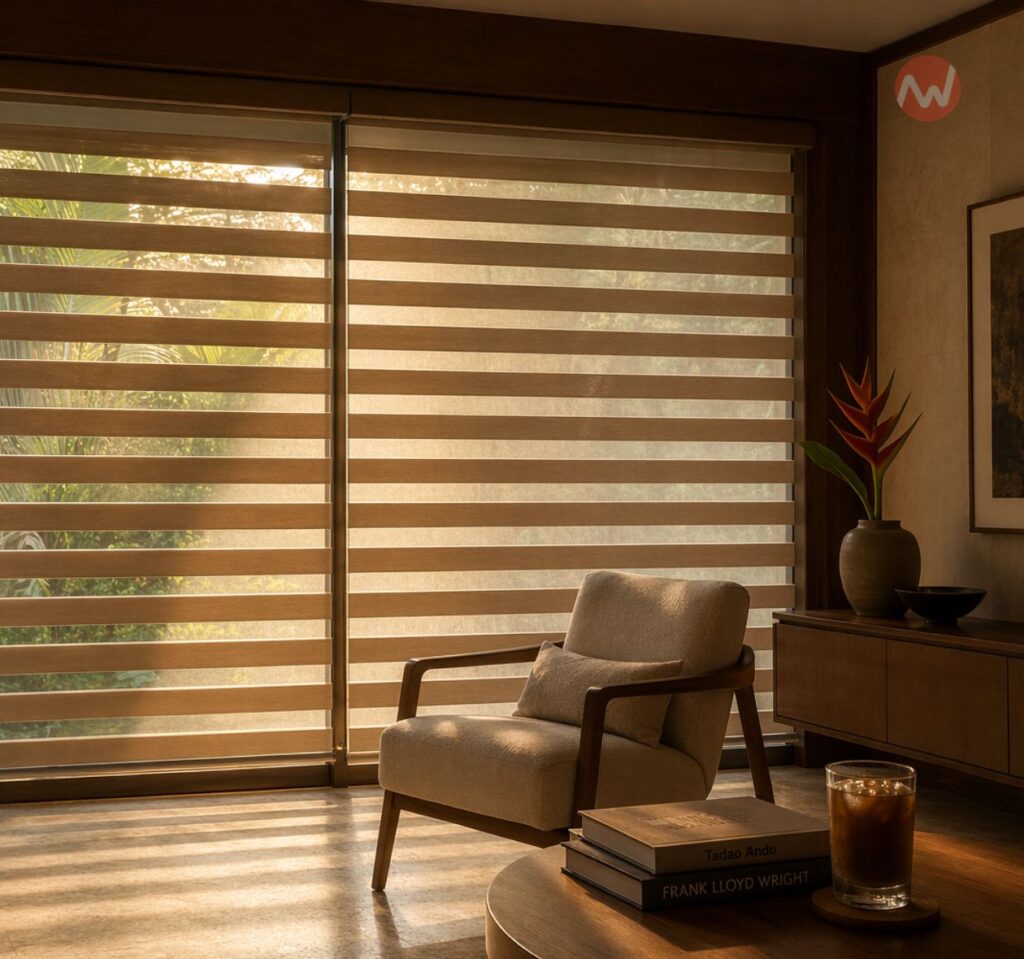
Daylight without giving up the room.
You came to the zebra format because a single fabric on a roller forced a choice you did not want to make. Open meant the room was visible from the road. Closed meant the room was dark. The Lutron Zebra Shade is one continuous fabric with sheer and opaque bands woven in alternating rows. The same rotation that opens the shade slides one set of bands over the other. Sheer over sheer, and the room receives soft daylight. Sheer over opaque, and the daylight cuts but the room stays one tone. Opaque over opaque, and the room closes. One fabric. Four states.
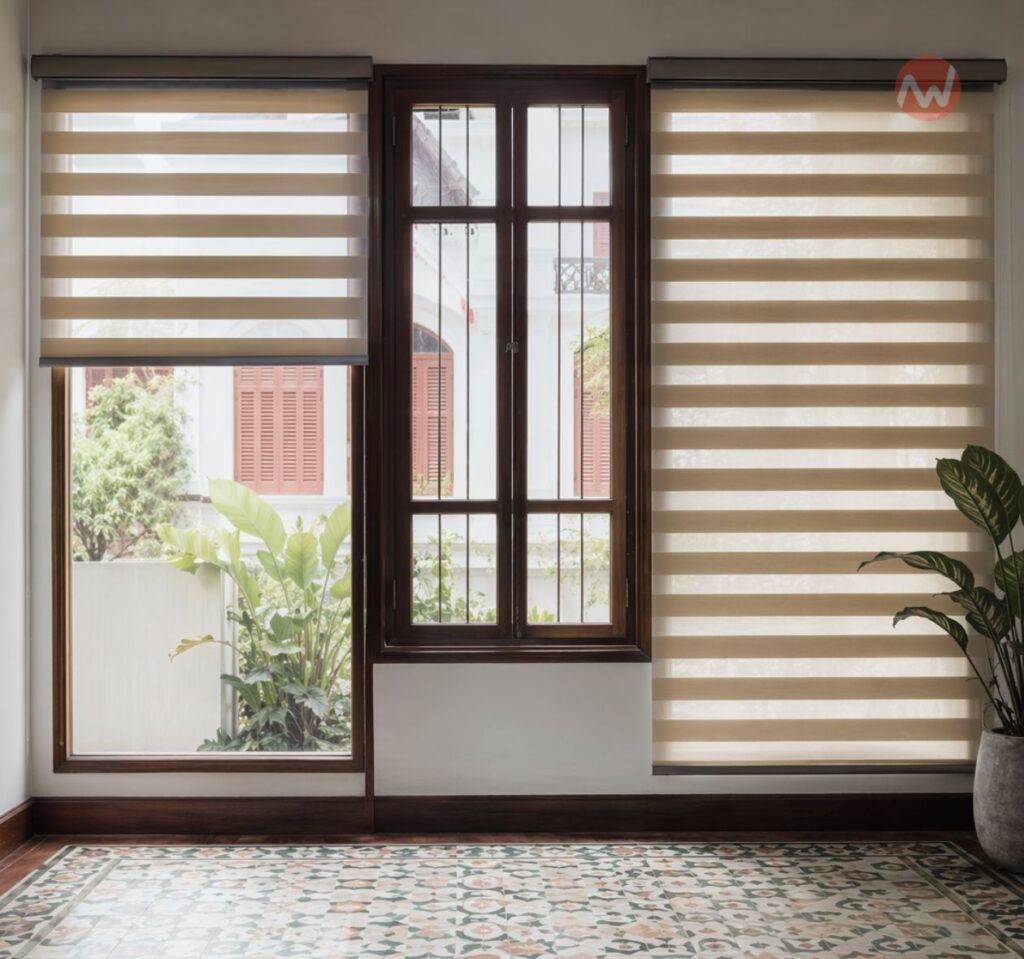
Daylight without giving up the room.
You came to the zebra format because a single fabric on a roller forced a choice you did not want to make. Open meant the room was visible from the road. Closed meant the room was dark. The Lutron Zebra Shade is one continuous fabric with sheer and opaque bands woven in alternating rows. The same rotation that opens the shade slides one set of bands over the other. Sheer over sheer, and the room receives soft daylight. Sheer over opaque, and the daylight cuts but the room stays one tone. Opaque over opaque, and the room closes. One fabric. Four states.
Full daylight.
The bands sit at the same point. Light passes at the openness factor of the sheer fabric. The window reads as glass with a soft veil.
Glare cut, view kept.
The bands shift halfway. Direct sun is diffused. The screen-side of the laptop holds. The outdoors stays visible.
In-between privacy.
The bands shift further. Soft daylight continues to enter. Visibility into the room drops. This is the state most homeowners run for the afternoon and the evening, and the reason they chose zebra over a single-fabric roller.
Full privacy.
Opaque aligns with opaque. Light blocking is governed by the fabric tier specified. Sheer tier closes the view without full darkness. Light-filtering diffuses further. Blackout closes the room to bedroom-and-media-room darkness.
Designed to disappear into your architecture.
In a room detailed by an architect, the zebra shade hides in the headrail line. The Lutron-motorised chassis recesses into the soffit pocket the architect reserved at first concept. The drive sits inside the chassis. The fabric is what you see. The mechanism is what you do not.
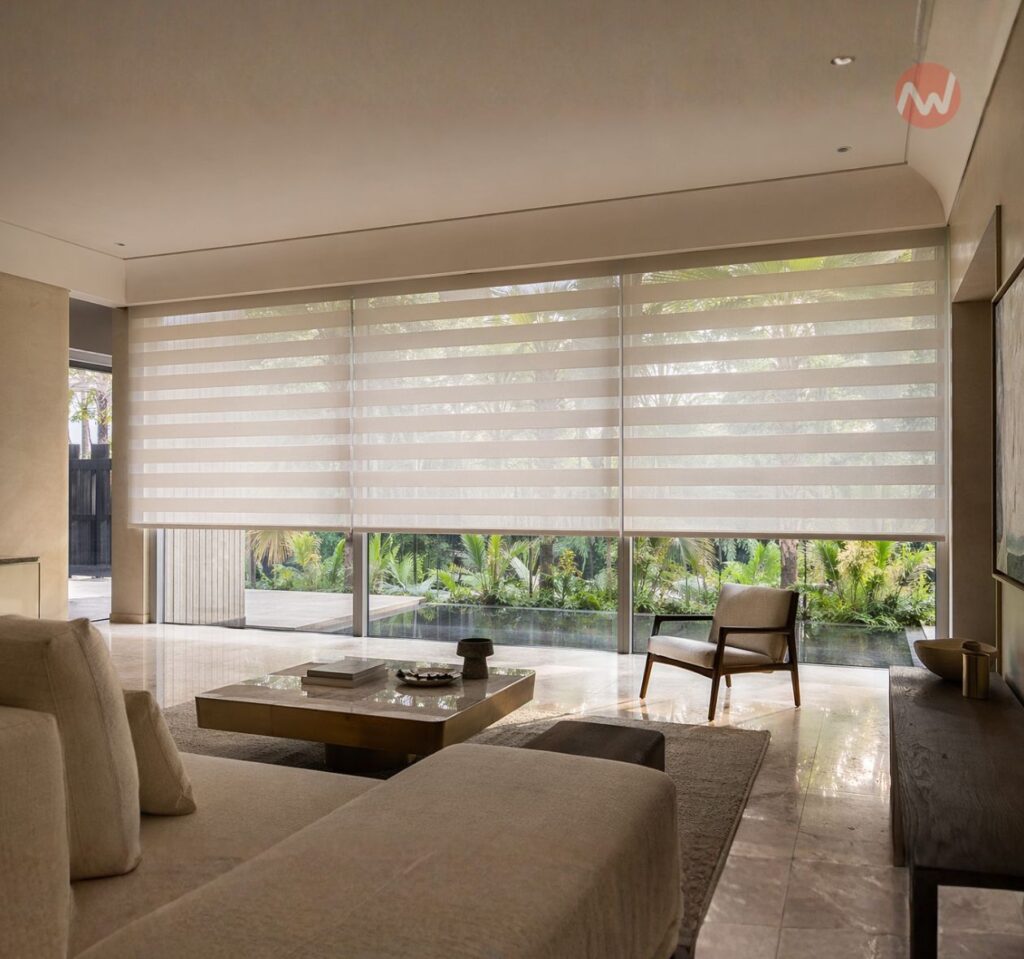
Designed to disappear into your architecture.
In a room detailed by an architect, the zebra shade hides in the headrail line. The Lutron-motorised chassis recesses into the soffit pocket the architect reserved at first concept. The drive sits inside the chassis. The fabric is what you see. The mechanism is what you do not.
Recessed into the ceiling pocket.
The cassette fascia carries a closed-head modern finish. The open-mount option leaves the headrail line minimal. In either option, the motor, the cabling, and the drive electronics stay inside the chassis. The reader of the room sees craft, not equipment.
Bracket-to-fabric clearance held at 0.75 inches (19 mm).
Symmetrical light gaps when the shade is sized to bracket-to-bracket distance. The window reads as a single fabric panel from the room side, not a panel inset between two structural strips.
Finished to the Lutron fabric library.
The Lutron Fabrics range is the natural pairing for the line. Phifer, Hunter Douglas, Copaco, and Mermet are also carried, in 300+ colours and 50+ designs across the sheer, light-filtering, and blackout tiers. Selection runs against the joinery palette during the M&E review, not after.
Hardware finishes coordinated to the fabric.
White, gray, bronze, and black on the chassis and brackets. The hardware reads as one tone with the fabric, the joinery, or both. The room does not collect four different metal tones at the head of every window.
Aligned across every window.
Across a wall of windows, every bottom bar lines up across the run. Intelligent Hembar Alignment holds bottom bars within 3 millimetres on grouped Lutron-motorised zebras, including at non-preset stops. A row of six living-room windows reads as one continuous treatment. The eye stops correcting.
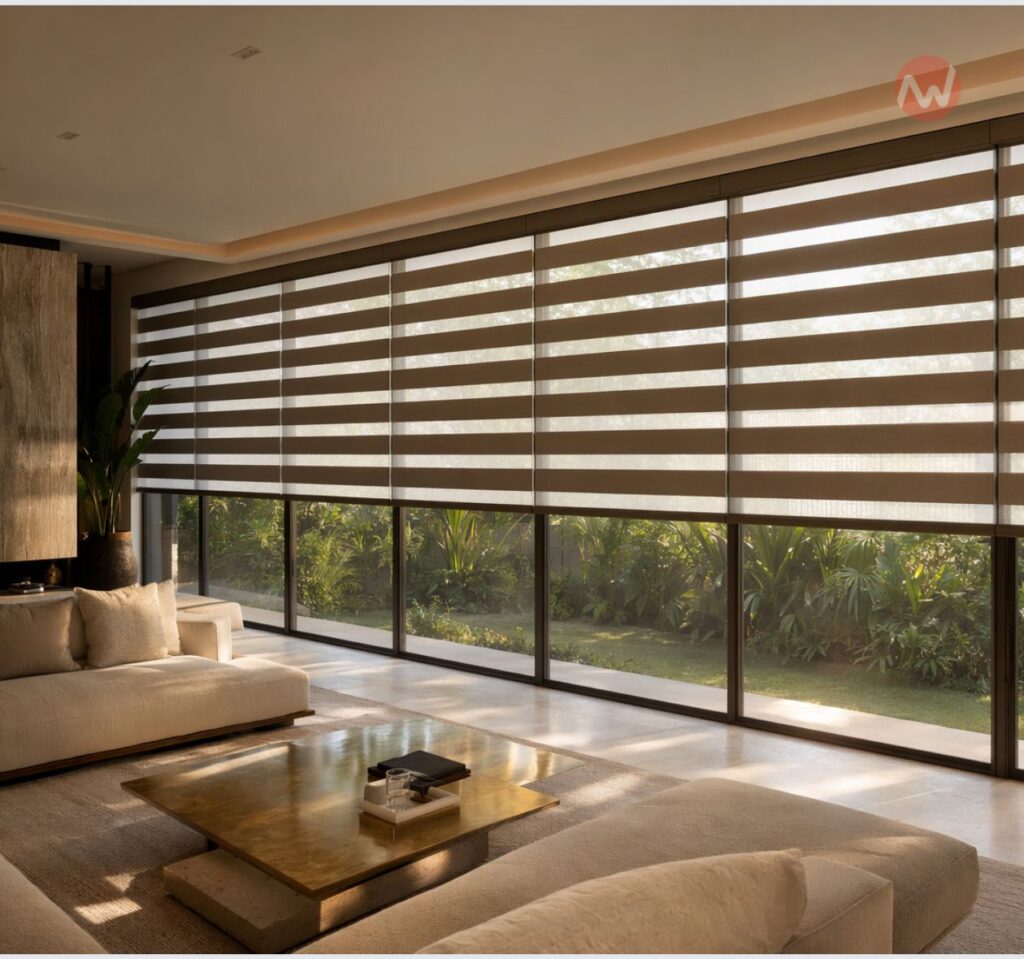
Aligned across every window.
Across a wall of windows, every bottom bar lines up across the run. Intelligent Hembar Alignment holds bottom bars within 3 millimetres on grouped Lutron-motorised zebras, including at non-preset stops. A row of six living-room windows reads as one continuous treatment. The eye stops correcting.
Bottom bars within 3 millimetres.
Position accuracy is held within 1/8 inch (3 mm) of programmed open, close, and preset positions. Grouped shades maintain the same tolerance across the run via IHA. The eye detects a quarter-inch difference at five feet. IHA holds the line below that threshold.
The motor stops where the program tells it to stop.
Each motor returns to the programmed limit within 3 millimetres on every cycle. The Welcome scene that drops the shades to a specific band alignment continues to drop them to the same alignment the next morning.
Stored presets, recalled to the millimetre.
Programming is retained through power loss for the product’s lifetime. The named scenes set in 2026 run to the same positions in 2036. No re-programming. No factory reset.
Quiet enough to forget.
The Lutron Zebra Shade motor will not exceed 35 dBA measured at three feet. That is roughly the level of a quiet library. A bedside reader will not hear it. A guestroom sleeper will not be roused. The room stays as you left it.
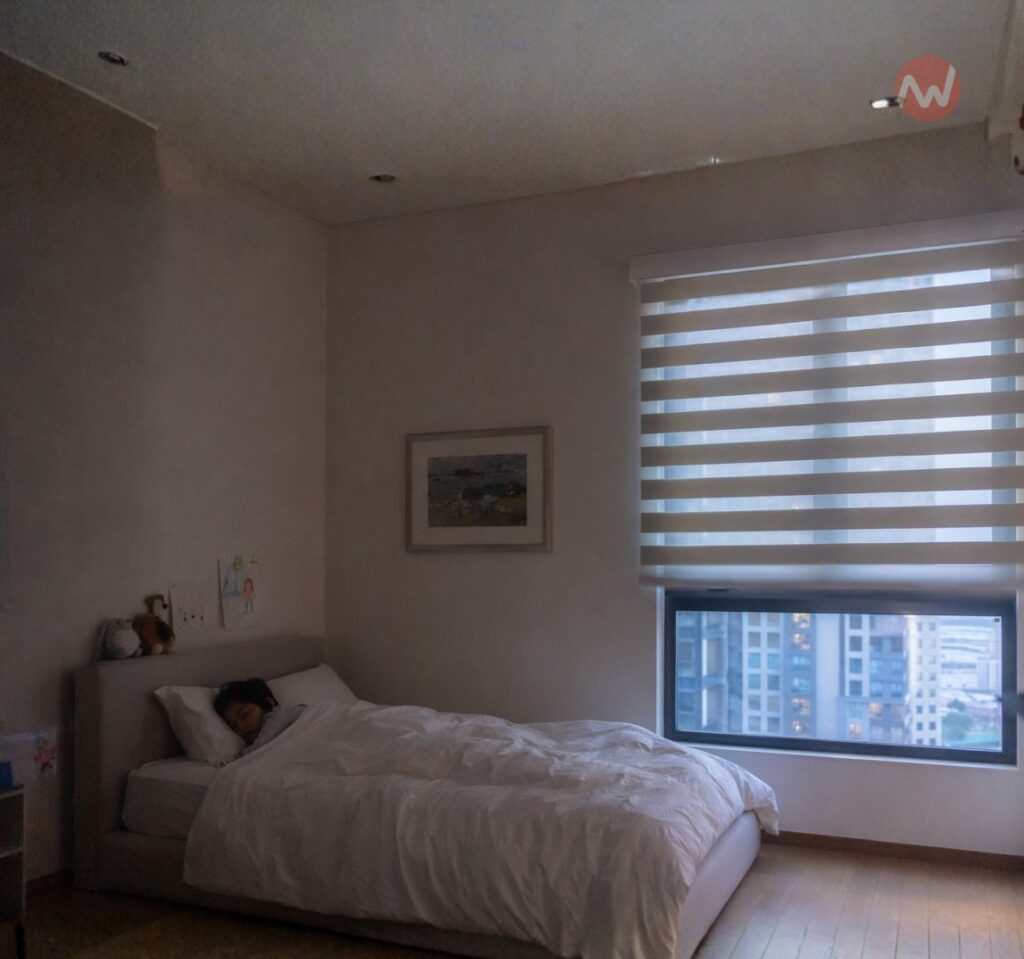
Quiet enough to forget.
The Lutron Zebra Shade motor will not exceed 35 dBA measured at three feet. That is roughly the level of a quiet library. A bedside reader will not hear it. A guestroom sleeper will not be roused. The room stays as you left it.
35 dBA at three feet.
The motor is documented at no more than 35 dBA measured 3 feet (1 m) from the chassis. Quieter than a refrigerator hum. Quieter than the air conditioning. In a bedroom at 3 a.m., the shade moves and the room stays still.
Soft start, soft stop.
The drive accelerates gradually and decelerates the same way. There is no click at the start and no thud at the bottom of the travel. The shade moves the way a hand would move it, if a hand had the patience.
Position retention through power loss.
Programmed limits and presets survive a power outage and stay accurate for the product’s lifetime. The shades return to the same positions after the power cuts back in.
Six Newton-metres of quiet torque.
The motor rates at 6 Nm. The fabric moves smoothly across the widest windows in the range (12 ft on the WIDR option) without the drive having to work into its limits, which is where motors get noisy.
On the same bus as your lights.
The Lutron Zebra Shade wakes up on the same processor that already runs the home. The keypad scene that opens the morning includes the zebra. The Lutron app shows the zebra beside the lighting on the same screen. The shade becomes a layer of the home, not a device on a separate system.
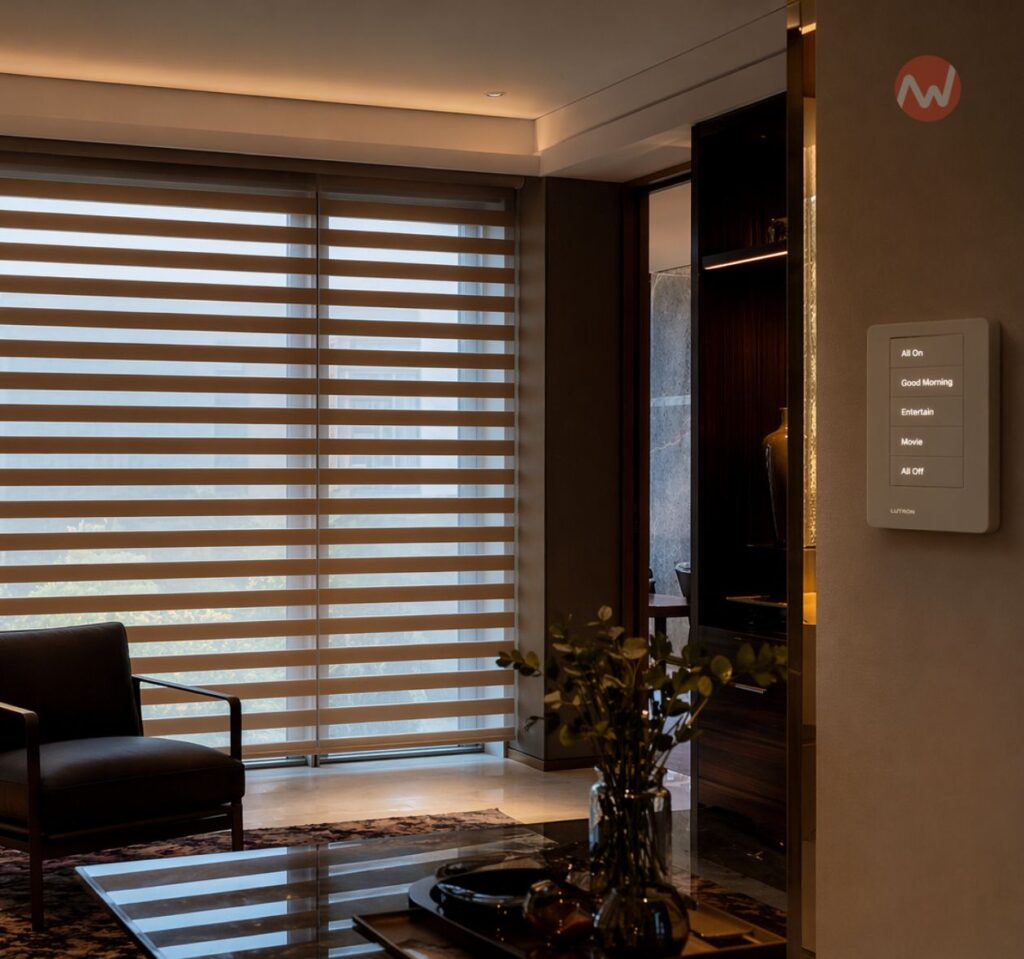
On the same bus as your lights.
The Lutron Zebra Shade wakes up on the same processor that already runs the home. The keypad scene that opens the morning includes the zebra. The Lutron app shows the zebra beside the lighting on the same screen. The shade becomes a layer of the home, not a device on a separate system.
Lutron Clear Connect RF, native.
The Lutron motor option runs on the Clear Connect RF protocol, the same wireless layer carrying the rest of the Lutron portfolio. The integration with the project’s existing Lutron processor is confirmed at the M&E review.
Voice via HomeKit, Alexa, and Google Home.
Apple HomeKit support comes through the Lutron motor option. Amazon Alexa and Google Home are direct. The phrase that already lowers the lights in the master bedroom also lowers the zebra.
Pico remotes and the Lutron app.
The Pico remote that runs the evening scene also adjusts the zebra. The Lutron app on the homeowner’s phone reaches the shade the same way it reaches the lighting and the existing roller shades.
100 devices, 100 zones standalone.
On a standalone deployment without a central processor, the Lutron Zebra runs in clusters of up to 100 devices across 100 zones. The same scene structure scales from a single window to whole-home coverage.
Specified before the ceiling closes.
The zebra shade that disappears into the architecture is the zebra shade that was specified when the ceilings were still open. The Lutron Zebra Shade is hardwired on Class 2, 35 V low-voltage cabling. The wiring decisions happen during M&E, not after move-in.
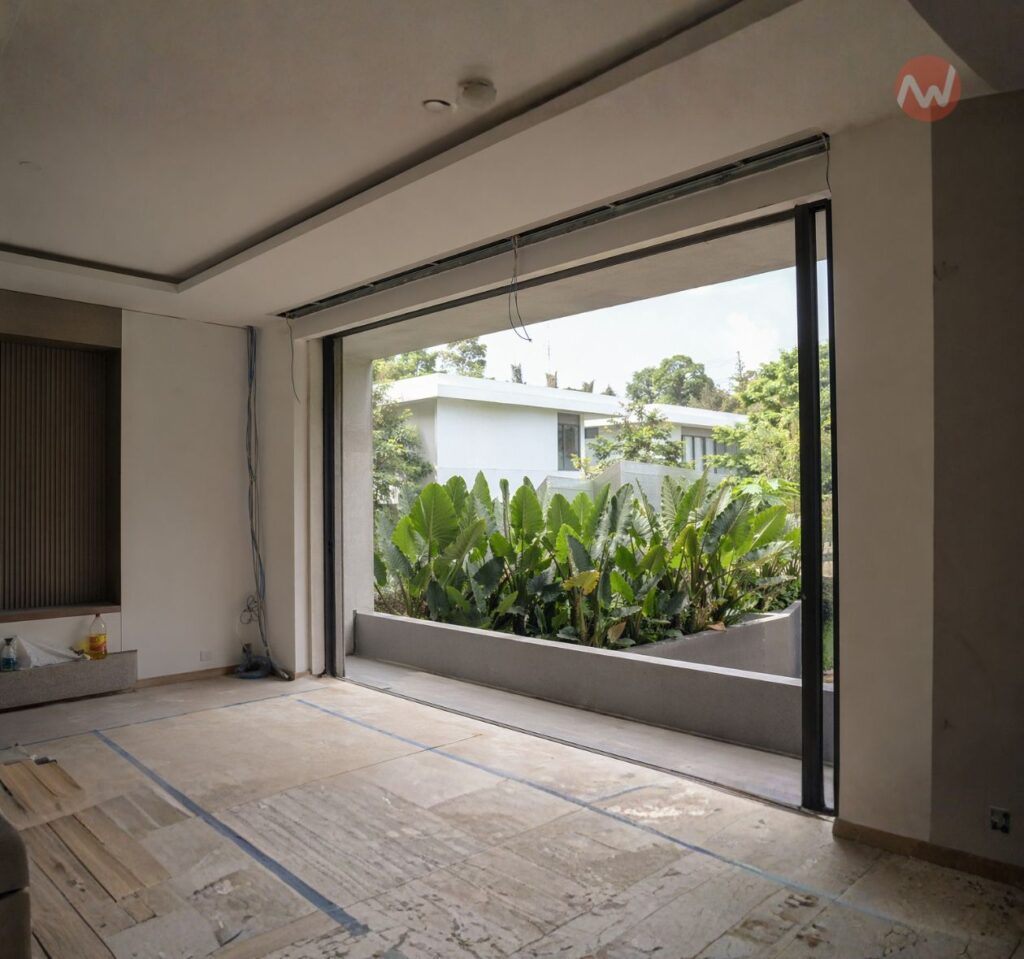
Specified before the ceiling closes.
The zebra shade that disappears into the architecture is the zebra shade that was specified when the ceilings were still open. The Lutron Zebra Shade is hardwired on Class 2, 35 V low-voltage cabling. The wiring decisions happen during M&E, not after move-in.
A conversation with the architect, the ID, and the AV integrator.
We sit with the architect, the interior designer, and the AV integrator before the joinery is finalised. We walk through chassis sizing, pocket depth, fascia profile, fabric selection, dual-mount option, and keypad locations. The zebra is detailed into the room, not retrofitted onto it.
A mock-up before mass production.
Per CSI 12 22 16 workflow, we mock up the sheer and the opaque, the openness factor of the sheer, and the integration scene before any shade is fabricated. The homeowner, the spouse, and the ID approve the look in the showroom. Mass production starts after sign-off.
Five questions for your architect.
Before the ceiling closes: where does the chassis recess. What is the wiring path from the Lutron QS bus to the headrail. Which scenes will the zebra appear in. Which Pico or keypad runs which group. Which sheer-and-opaque pairing matches the orientation and the glazing. Ask these now, not after move-in.
Standard, Aqara, or Lutron: choose by control system.
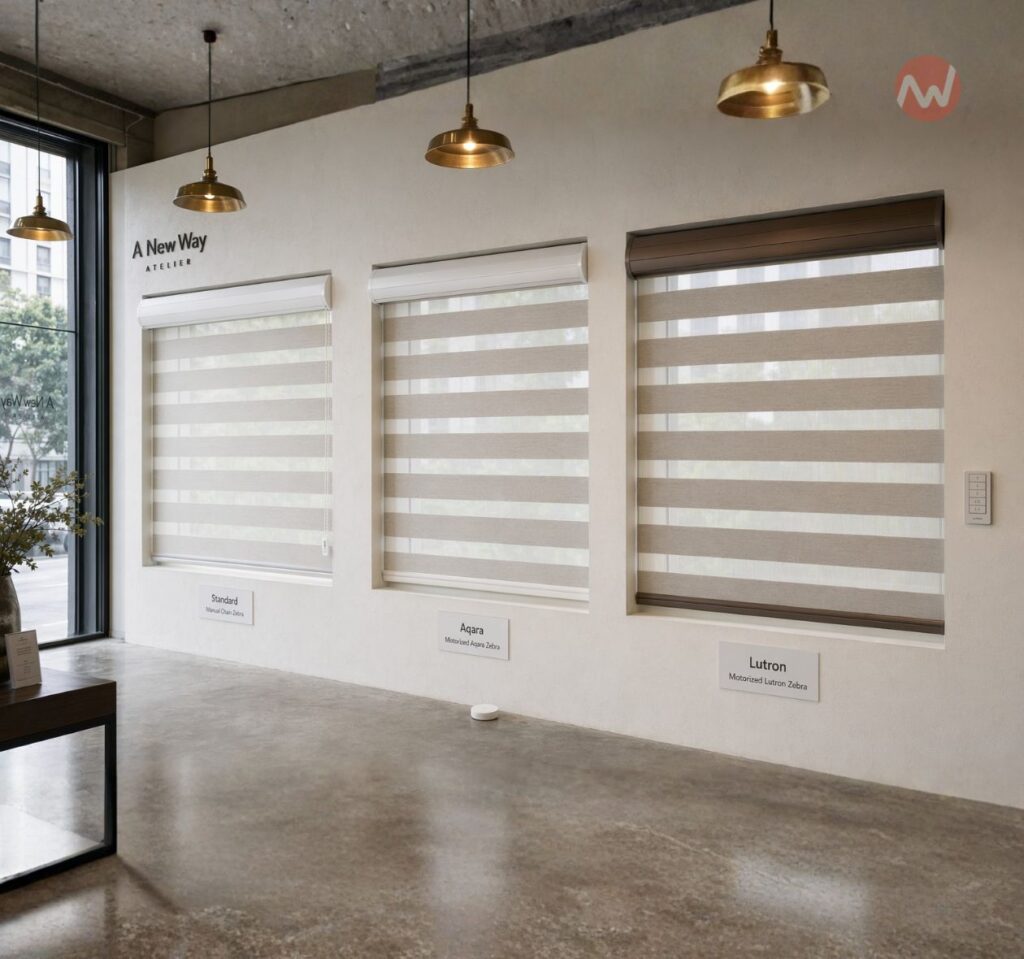
The day-night zebra format runs across three lines in the New Way portfolio, each keyed to the home's control system. The Lutron Zebra is the line specified when the home is already running on a Lutron processor. The decision between the three is rarely contested once the integration path is on the table.
Standard, Aqara, or Lutron: choose by control system.
The day-night zebra format runs across three lines in the New Way portfolio, each keyed to the home's control system. The Lutron Zebra is the line specified when the home is already running on a Lutron processor. The decision between the three is rarely contested once the integration path is on the table.
Standard Zebra: manual chain, no motor.
The entry-tier line. Manual chain operation. Same chassis logic, same three fabric tiers, same fabric library. Specified when the brief stops at a clean manual upgrade or when the smart-home commitment is still forming.
Aqara Zebra: motorised, Aqara hub.
The mid-range line. Motorised, runs on the Aqara hub for HomeKit, Alexa, and Google Home control. Specified when the home is on the Aqara ecosystem rather than the Lutron one. Strong for primary bedrooms and secondary spaces in homes not specified through to Lutron.
Lutron Zebra: motorised, Lutron motor option.
The ultra-premium line. Same documented motor baseline (6 Nm, 35 dBA, 3 mm position accuracy), with the Lutron motor option on Clear Connect RF rather than the Aqara hub. The line for homes already on Lutron lighting and shading, where the zebra becomes another layer on the same control bus.
The atelier reviews each project at the M&E stage.
The control-system decision lands before the chassis is sized. The atelier walks through the home’s existing processor (or the one being specified), the fabric library, the dual-mount option, and the keypad locations before the line is confirmed.
Complete Technical Specifications for Lutron Zebra Shades
How does the Lutron Zebra Shade day-night band logic deliver four states of daylight?
The Lutron Zebra Shade is a single fabric chassis carrying alternating sheer and opaque bands woven on one looped fabric, so rotating the tube slides one set of bands over the other to deliver four daylight states on the same window: full daylight (sheer over sheer), glare cut with view kept (bands offset halfway), in-between privacy (bands offset further), and full privacy (opaque over opaque), per the Lutron Zebra Shades Product Knowledge entry (2026).
Living rooms with floor-to-ceiling glass, primary bedrooms with afternoon sun, and home offices where glare on screens is the first thing to manage.
Full daylight
Sheer bands align with sheer bands at the same point on the rotation. Light passes through both layers at the openness factor of the sheer fabric. The window reads as glass with a soft veil. This state is the default for daytime use and is the position the homeowner runs while the room is in active use.
Glare cut, view kept
The bands shift halfway across the rotation. Direct sun is diffused, the screen-side of the laptop holds against the window light, and the outdoors stays visible. The state runs without scheduling and is recalled to a Pico remote or a keypad scene by the household.
In-between privacy
The bands shift further. Soft daylight continues to enter the room. Visibility into the room from the road or the garden drops to a level where activity is no longer readable. This is the state most homeowners run for the afternoon and the evening, and the reason they chose zebra over a single-fabric roller.
Full privacy
Opaque aligns with opaque. Light blocking is governed by the fabric tier specified: sheer tier closes the view without darkening the room, light-filtering diffuses daylight further, blackout closes the room to bedroom-and-media-room darkness. Fabric tier is selected room-by-room at the M&E review.
Four states recalled from one keypad
Each of the four states is a stored preset on the Lutron motor and is recalled within 3 millimetres of the programmed position. Programming is retained through power loss for the product's lifetime. The household names the scenes and the bands move to the named state from the keypad.
What materials are Lutron Zebra Shades made from?
Lutron Zebra Shades use a looped fabric with alternating sheer and opaque bands woven in one panel, mounted on a Lutron-motorised aluminium chassis with the precision drive housed inside the chassis, available across the full Lutron Fabrics library plus Phifer, Hunter Douglas, Copaco, and Mermet ranges, with 300-plus colours and 50-plus designs across three fabric tiers (sheer, light-filtering, blackout), per the Lutron Zebra Shades Product Knowledge entry (2026).
Luxury residential projects where the fabric must coordinate with the joinery palette and where the chassis must recess into an architectural soffit without altering the headrail line.
Fabric construction
The shade is a single looped fabric with alternating bands of sheer and opaque woven into one panel. The bands rotate around the tube as the drive turns, sliding one band over the other to deliver the four daylight states. Heat-cut edges minimise curling. Edge binding is available where the shade ends sit visible against the joinery.
Fabric tiers and library
Three fabric tiers are available: sheer (highest openness, daytime privacy with daylight), light-filtering (diffuses glare in living and dining rooms), and blackout (bedroom and media-room darkness when bands align opaque-over-opaque). Named fabric supplier brands carried: Phifer, Hunter Douglas, Copaco, Mermet, and Lutron Fabrics. The Lutron Fabrics range is the natural pairing for the Lutron motor option. 300-plus colours and 50-plus designs across the named ranges.
Chassis and hardware
The chassis is aluminium, with the Lutron precision drive housed inside. The drive sits inside the headrail; only the fabric and the optional cassette fascia are visible from the room. Hardware finishes are available in white, gray, bronze, and black. Bracket-to-fabric clearance is held at 0.75 in (19 mm) so symmetrical light gaps result when the shade is sized to bracket-to-bracket distance.
Hembar and edge stability
The hembar is the weighted lower bar that keeps the fabric flat and aligned. Edge stability is held across temperature and humidity within the documented operating envelope (32 to 104 deg F, 0 to 90 percent humidity, non-condensing). Heat-cut edges resist curl in tropical sun and humidity exposure.
Fascia and dual-mount options
Two fascia treatments: cassette (closed-head, modern finish) and open (minimal headrail line for spaces where the chassis reads as part of the architecture). An optional dual-mount bracket holds two fabric rolls on the same window, typically pairing a sheer zebra with a separate blackout for combined day and night states in a primary bedroom.
How big can a single Lutron Zebra Shade go?
A single Lutron Zebra Shade covers windows from 17.5 in (444.5 mm) wide up to 8 ft (2.438 m) wide in the standard configuration, scaling to 12 ft (3.657 m) wide with the WIDR option (subject to fabric limits), with grouped-shade alignment held within 1/8 in (3 mm) via Intelligent Hembar Alignment, per the Lutron Zebra Shades Product Knowledge entry (2026).
Living rooms with floor-to-ceiling glass and primary bedrooms with full-height windows, where a single shade serves a wide opening without a coupling joint across the run.
Standard width range
Standard widths run from 17.5 in (444.5 mm) at the lower bound to 8 ft (2.438 m) at the upper bound on the Lutron motor configuration. The lower bound supports narrow windows beside doors and side-glazing returns. The upper bound covers most single-window openings in luxury residential.
Wide width with the WIDR option
The Wide Width Roller (WIDR) option extends the maximum width to 12 ft (3.657 m), subject to fabric limits. The option is specified for living-room picture windows and primary-bedroom full-height openings where a single shade serves the opening without a coupling joint that would interrupt the band line.
Multi-shade alignment across grouped windows
On adjacent zebras across a wall of glass, Intelligent Hembar Alignment holds bottom bars within 1/8 in (3 mm) of each other at all stops, including non-preset stops. A row of grouped zebras reads as one continuous treatment from the room.
Height range
Height is specified to the window opening. The practical height limit is governed by the fabric supplier's panel limit at the chosen tier and finish. Confirmation runs at the M&E review against the Lutron Fabrics or named-supplier panel [verify with team].
Fabric tier governs the practical width-height combination
Wider widths on blackout tier carry more weight than wider widths on sheer tier, which affects the drive torque margin. The Lutron motor at 6 Nm is rated to handle the documented width range across all three fabric tiers within the standard envelope.
How quiet is the Lutron Zebra Shade motor at three feet?
The Lutron Zebra Shade motor will not exceed 35 dBA measured at three feet (1 m) from the chassis, with soft-start and soft-stop motion profiles and 6 Nm of drive torque, per the Lutron Zebra Shades Product Knowledge entry (2026). The register sits roughly at the threshold of a quiet library.
Bedroom, nursery, home-office, and theatre installations where motorised motion needs to remain inaudible at sleep and conversation distance.
35 dBA at three feet
The motor is rated at no more than 35 dBA measured 3 ft (1 m) from the chassis. The register sits below typical air-conditioning hum and below conversation volume. A bedside reader will not hear the shade rise. A guestroom sleeper will not be roused.
Soft start, soft stop motion profile
The drive accelerates gradually at the start of motion and decelerates gradually at the end. There is no click at the start and no thud at the bottom of the travel. The shade moves the way a hand would move it, if a hand had the patience.
Quiet torque across the width range
The motor rates at 6 Nm. Across the documented width range up to 12 ft (3.657 m) on the WIDR option, the drive has torque margin to move the fabric smoothly without working into its mechanical limits, which is where motors get noisier across the category.
Position retention through power loss
Programmed limits and presets survive a power outage and stay accurate for the product's lifetime. The shades return to the same positions after the power cuts back in. No re-programming or factory reset is required.
Acoustic-and-precision pairing
The 35 dBA acoustic envelope is held alongside position accuracy of 1/8 in (3 mm) on each shade and bottom-bar alignment of 1/8 in (3 mm) across grouped shades via Intelligent Hembar Alignment. Quiet motion is not delivered at the cost of position drift.
What smart-home systems work with Lutron Zebra Shades?
Lutron Zebra Shades integrate natively with the Lutron Clear Connect RF protocol on the Lutron motor option and reach Apple HomeKit, Amazon Alexa, and Google Home through Lutron bridges, with Pico wireless remotes and the Lutron app carrying daily control, per the Lutron Zebra Shades Product Knowledge entry (2026). Specific Lutron control-system tier pairings are confirmed at the project's M&E review.
Lutron-equipped luxury residences where the zebra must sit on the same control bus as the lighting, the drapery, and the climate without a third-party bridge.
Lutron Clear Connect RF, native
The Lutron motor option runs on the Lutron Clear Connect RF wireless protocol, the same layer carrying the rest of the Lutron portfolio across the home. The shade wakes up on the project's existing Lutron control system without a third-party bridge or dry-contact closure.
Voice via Apple HomeKit, Amazon Alexa, and Google Home
Apple HomeKit support is documented through the Lutron motor option itself. Amazon Alexa and Google Home are supported directly. The voice command that already lowers the lights in the master bedroom also lowers the zebra to the named state.
Pico remotes and the Lutron app
Pico wireless remotes and the Lutron app on iOS and Android both reach the zebra. The Pico that runs the evening scene also adjusts the zebra to the in-between privacy state. Custom keypad engravings align the zebra with the scenes the household already runs.
Standalone deployment capacity
On a standalone deployment without a central Lutron processor, the system runs in clusters of up to 100 devices across 100 zones. The same scene structure scales from a single window to whole-home coverage.
Lutron control system pairings
Specific support for the Lutron Caseta, RadioRA 3, and HomeWorks tiers is confirmed at the project's M&E review against the existing processor [verify with team]. The HomeKit, Alexa, and Google Home reach is documented through the Lutron motor itself in all cases.
How are Lutron Zebra Shades installed, powered, and warranted?
Lutron Zebra Shades are hardwired on Class 2, 35 V DC low-voltage cabling with mounting in pocket, inside, or outside configurations, and carry the Lutron Eight-Year Limited Warranty on materials and the electronic drive unit (100 percent parts coverage for the first five years, pro-rated through year eight, no registration required) plus a New Way Five-Year fabrication wrap on the fabric, the chassis, and the drive housing, per the Lutron Zebra Shades Product Knowledge entry (2026) and the Lutron Window Systems Warranty document (2025).
Luxury residential projects in design specification at the M&E stage, where pocket details, soffit recess, and low-voltage runs can be detailed before the joinery closes.
Wiring class and voltage
The Lutron motor option runs on Class 2, 35 V DC low-voltage wiring. Wiring decisions are confirmed at the M&E review against the project's Lutron specification submittal so the run from the Lutron control system to the headrail is in place before the ceiling closes.
Mounting options
Pocket mount for design-led recessed installations. Inside mount (jamb) for surface-mounted clean installs. Outside mount (above trim or on trim) for openings without recess capacity. Drive side (left or right) and roll direction (regular or reverse) are specified at order to suit room layout, clearance, and handles.
Operating envelope
The system operates between 0 and 40 deg C (32 to 104 deg F) at 0 to 90 percent humidity, non-condensing. The envelope covers normal Malaysian and Singaporean residential conditions without derating.
Lutron Eight-Year Limited Warranty
Lutron covers materials and the electronic drive unit for eight years from shipment. 100 percent parts coverage for the first five years. Pro-rated coverage through year eight. No registration required, per the Lutron Window Systems Warranty document (2025).
New Way Five-Year fabrication wrap
New Way adds a five-year fabrication wrap on top of the Lutron warranty, covering the fabric, the chassis, and the drive housing. The wrap is the local-service layer that handles fabrication-specific issues without the homeowner needing to escalate to Lutron directly.
Safety and regulatory
ANSI/WCMA A100.1 compliance for window-covering safety. Qualifies as WCMA Best for Kids because motorisation removes hanging cords. UL 1310 Class 2 power supplies. UL listed and cUL listed. FCC Part 15. Detailed listing IDs and certificate numbers confirmed against the Lutron submittal at the M&E review [verify with team].
The Lutron Zebra Shade is a single fabric chassis carrying alternating sheer and opaque bands woven on one looped fabric, so rotating the tube slides one set of bands over the other to deliver four daylight states on the same window: full daylight (sheer over sheer), glare cut with view kept (bands offset halfway), in-between privacy (bands offset further), and full privacy (opaque over opaque), per the Lutron Zebra Shades Product Knowledge entry (2026).
Living rooms with floor-to-ceiling glass, primary bedrooms with afternoon sun, and home offices where glare on screens is the first thing to manage.
Full daylight
Sheer bands align with sheer bands at the same point on the rotation. Light passes through both layers at the openness factor of the sheer fabric. The window reads as glass with a soft veil. This state is the default for daytime use and is the position the homeowner runs while the room is in active use.
Glare cut, view kept
The bands shift halfway across the rotation. Direct sun is diffused, the screen-side of the laptop holds against the window light, and the outdoors stays visible. The state runs without scheduling and is recalled to a Pico remote or a keypad scene by the household.
In-between privacy
The bands shift further. Soft daylight continues to enter the room. Visibility into the room from the road or the garden drops to a level where activity is no longer readable. This is the state most homeowners run for the afternoon and the evening, and the reason they chose zebra over a single-fabric roller.
Full privacy
Opaque aligns with opaque. Light blocking is governed by the fabric tier specified: sheer tier closes the view without darkening the room, light-filtering diffuses daylight further, blackout closes the room to bedroom-and-media-room darkness. Fabric tier is selected room-by-room at the M&E review.
Four states recalled from one keypad
Each of the four states is a stored preset on the Lutron motor and is recalled within 3 millimetres of the programmed position. Programming is retained through power loss for the product's lifetime. The household names the scenes and the bands move to the named state from the keypad.
Lutron Zebra Shades use a looped fabric with alternating sheer and opaque bands woven in one panel, mounted on a Lutron-motorised aluminium chassis with the precision drive housed inside the chassis, available across the full Lutron Fabrics library plus Phifer, Hunter Douglas, Copaco, and Mermet ranges, with 300-plus colours and 50-plus designs across three fabric tiers (sheer, light-filtering, blackout), per the Lutron Zebra Shades Product Knowledge entry (2026).
Luxury residential projects where the fabric must coordinate with the joinery palette and where the chassis must recess into an architectural soffit without altering the headrail line.
Fabric construction
The shade is a single looped fabric with alternating bands of sheer and opaque woven into one panel. The bands rotate around the tube as the drive turns, sliding one band over the other to deliver the four daylight states. Heat-cut edges minimise curling. Edge binding is available where the shade ends sit visible against the joinery.
Fabric tiers and library
Three fabric tiers are available: sheer (highest openness, daytime privacy with daylight), light-filtering (diffuses glare in living and dining rooms), and blackout (bedroom and media-room darkness when bands align opaque-over-opaque). Named fabric supplier brands carried: Phifer, Hunter Douglas, Copaco, Mermet, and Lutron Fabrics. The Lutron Fabrics range is the natural pairing for the Lutron motor option. 300-plus colours and 50-plus designs across the named ranges.
Chassis and hardware
The chassis is aluminium, with the Lutron precision drive housed inside. The drive sits inside the headrail; only the fabric and the optional cassette fascia are visible from the room. Hardware finishes are available in white, gray, bronze, and black. Bracket-to-fabric clearance is held at 0.75 in (19 mm) so symmetrical light gaps result when the shade is sized to bracket-to-bracket distance.
Hembar and edge stability
The hembar is the weighted lower bar that keeps the fabric flat and aligned. Edge stability is held across temperature and humidity within the documented operating envelope (32 to 104 deg F, 0 to 90 percent humidity, non-condensing). Heat-cut edges resist curl in tropical sun and humidity exposure.
Fascia and dual-mount options
Two fascia treatments: cassette (closed-head, modern finish) and open (minimal headrail line for spaces where the chassis reads as part of the architecture). An optional dual-mount bracket holds two fabric rolls on the same window, typically pairing a sheer zebra with a separate blackout for combined day and night states in a primary bedroom.
A single Lutron Zebra Shade covers windows from 17.5 in (444.5 mm) wide up to 8 ft (2.438 m) wide in the standard configuration, scaling to 12 ft (3.657 m) wide with the WIDR option (subject to fabric limits), with grouped-shade alignment held within 1/8 in (3 mm) via Intelligent Hembar Alignment, per the Lutron Zebra Shades Product Knowledge entry (2026).
Living rooms with floor-to-ceiling glass and primary bedrooms with full-height windows, where a single shade serves a wide opening without a coupling joint across the run.
Standard width range
Standard widths run from 17.5 in (444.5 mm) at the lower bound to 8 ft (2.438 m) at the upper bound on the Lutron motor configuration. The lower bound supports narrow windows beside doors and side-glazing returns. The upper bound covers most single-window openings in luxury residential.
Wide width with the WIDR option
The Wide Width Roller (WIDR) option extends the maximum width to 12 ft (3.657 m), subject to fabric limits. The option is specified for living-room picture windows and primary-bedroom full-height openings where a single shade serves the opening without a coupling joint that would interrupt the band line.
Multi-shade alignment across grouped windows
On adjacent zebras across a wall of glass, Intelligent Hembar Alignment holds bottom bars within 1/8 in (3 mm) of each other at all stops, including non-preset stops. A row of grouped zebras reads as one continuous treatment from the room.
Height range
Height is specified to the window opening. The practical height limit is governed by the fabric supplier's panel limit at the chosen tier and finish. Confirmation runs at the M&E review against the Lutron Fabrics or named-supplier panel [verify with team].
Fabric tier governs the practical width-height combination
Wider widths on blackout tier carry more weight than wider widths on sheer tier, which affects the drive torque margin. The Lutron motor at 6 Nm is rated to handle the documented width range across all three fabric tiers within the standard envelope.
The Lutron Zebra Shade motor will not exceed 35 dBA measured at three feet (1 m) from the chassis, with soft-start and soft-stop motion profiles and 6 Nm of drive torque, per the Lutron Zebra Shades Product Knowledge entry (2026). The register sits roughly at the threshold of a quiet library.
Bedroom, nursery, home-office, and theatre installations where motorised motion needs to remain inaudible at sleep and conversation distance.
35 dBA at three feet
The motor is rated at no more than 35 dBA measured 3 ft (1 m) from the chassis. The register sits below typical air-conditioning hum and below conversation volume. A bedside reader will not hear the shade rise. A guestroom sleeper will not be roused.
Soft start, soft stop motion profile
The drive accelerates gradually at the start of motion and decelerates gradually at the end. There is no click at the start and no thud at the bottom of the travel. The shade moves the way a hand would move it, if a hand had the patience.
Quiet torque across the width range
The motor rates at 6 Nm. Across the documented width range up to 12 ft (3.657 m) on the WIDR option, the drive has torque margin to move the fabric smoothly without working into its mechanical limits, which is where motors get noisier across the category.
Position retention through power loss
Programmed limits and presets survive a power outage and stay accurate for the product's lifetime. The shades return to the same positions after the power cuts back in. No re-programming or factory reset is required.
Acoustic-and-precision pairing
The 35 dBA acoustic envelope is held alongside position accuracy of 1/8 in (3 mm) on each shade and bottom-bar alignment of 1/8 in (3 mm) across grouped shades via Intelligent Hembar Alignment. Quiet motion is not delivered at the cost of position drift.
Lutron Zebra Shades integrate natively with the Lutron Clear Connect RF protocol on the Lutron motor option and reach Apple HomeKit, Amazon Alexa, and Google Home through Lutron bridges, with Pico wireless remotes and the Lutron app carrying daily control, per the Lutron Zebra Shades Product Knowledge entry (2026). Specific Lutron control-system tier pairings are confirmed at the project's M&E review.
Lutron-equipped luxury residences where the zebra must sit on the same control bus as the lighting, the drapery, and the climate without a third-party bridge.
Lutron Clear Connect RF, native
The Lutron motor option runs on the Lutron Clear Connect RF wireless protocol, the same layer carrying the rest of the Lutron portfolio across the home. The shade wakes up on the project's existing Lutron control system without a third-party bridge or dry-contact closure.
Voice via Apple HomeKit, Amazon Alexa, and Google Home
Apple HomeKit support is documented through the Lutron motor option itself. Amazon Alexa and Google Home are supported directly. The voice command that already lowers the lights in the master bedroom also lowers the zebra to the named state.
Pico remotes and the Lutron app
Pico wireless remotes and the Lutron app on iOS and Android both reach the zebra. The Pico that runs the evening scene also adjusts the zebra to the in-between privacy state. Custom keypad engravings align the zebra with the scenes the household already runs.
Standalone deployment capacity
On a standalone deployment without a central Lutron processor, the system runs in clusters of up to 100 devices across 100 zones. The same scene structure scales from a single window to whole-home coverage.
Lutron control system pairings
Specific support for the Lutron Caseta, RadioRA 3, and HomeWorks tiers is confirmed at the project's M&E review against the existing processor [verify with team]. The HomeKit, Alexa, and Google Home reach is documented through the Lutron motor itself in all cases.
Lutron Zebra Shades are hardwired on Class 2, 35 V DC low-voltage cabling with mounting in pocket, inside, or outside configurations, and carry the Lutron Eight-Year Limited Warranty on materials and the electronic drive unit (100 percent parts coverage for the first five years, pro-rated through year eight, no registration required) plus a New Way Five-Year fabrication wrap on the fabric, the chassis, and the drive housing, per the Lutron Zebra Shades Product Knowledge entry (2026) and the Lutron Window Systems Warranty document (2025).
Luxury residential projects in design specification at the M&E stage, where pocket details, soffit recess, and low-voltage runs can be detailed before the joinery closes.
Wiring class and voltage
The Lutron motor option runs on Class 2, 35 V DC low-voltage wiring. Wiring decisions are confirmed at the M&E review against the project's Lutron specification submittal so the run from the Lutron control system to the headrail is in place before the ceiling closes.
Mounting options
Pocket mount for design-led recessed installations. Inside mount (jamb) for surface-mounted clean installs. Outside mount (above trim or on trim) for openings without recess capacity. Drive side (left or right) and roll direction (regular or reverse) are specified at order to suit room layout, clearance, and handles.
Operating envelope
The system operates between 0 and 40 deg C (32 to 104 deg F) at 0 to 90 percent humidity, non-condensing. The envelope covers normal Malaysian and Singaporean residential conditions without derating.
Lutron Eight-Year Limited Warranty
Lutron covers materials and the electronic drive unit for eight years from shipment. 100 percent parts coverage for the first five years. Pro-rated coverage through year eight. No registration required, per the Lutron Window Systems Warranty document (2025).
New Way Five-Year fabrication wrap
New Way adds a five-year fabrication wrap on top of the Lutron warranty, covering the fabric, the chassis, and the drive housing. The wrap is the local-service layer that handles fabrication-specific issues without the homeowner needing to escalate to Lutron directly.
Safety and regulatory
ANSI/WCMA A100.1 compliance for window-covering safety. Qualifies as WCMA Best for Kids because motorisation removes hanging cords. UL 1310 Class 2 power supplies. UL listed and cUL listed. FCC Part 15. Detailed listing IDs and certificate numbers confirmed against the Lutron submittal at the M&E review [verify with team].
Authorized Fabricator for Renson, Aqara, Lutron
New Way is the licensed Renson Fixscreen fabricator and installer for Malaysia and Singapore, a Lutron-approved fabricator since 2022, and an Aqara partner. The Standard Cable-Guided line on this page is the entry rung of the New Way outdoor ladder. For hospitality references and hurricane wind class, route to Renson Fixscreen.



Trust, Reach & Recognition
New Way Group, founded 1993; full pivot to intelligent shading in 2018; Singapore entity since 2025.
Licensed Renson Fixscreen fabricator and installer for Malaysia and Singapore. Lutron-approved fabricator since 2022.
316 marine-grade stainless hardware throughout, 10+ year operating life, 3-year system and 5-year motor warranty.
Products Reviews
Frequently Asked Questions
Pre-Sales
Standard, Aqara, or Lutron: which Lutron Zebra line is right for our home?
Lutron Zebra Shades run as the ultra-premium tier in a three-line zebra ladder, sized to the home’s control system. Standard Zebra is the manual chain line for value-tier projects without smart-home commitment. Aqara Zebra is the motorised mid-range line for homes already on the Aqara hub with HomeKit, Alexa, and Google Home routing. Lutron Zebra is the motorised ultra-premium line for homes running a Lutron processor for the lighting and the shading on the same Clear Connect RF bus. The decision lands at the M&E review against the home’s existing or planned control system. For projects already specified through to Lutron lighting, the Lutron Zebra is the only line that keeps the shade on the same control bus without a third-party bridge.
How do Lutron Zebra Shades compare to Lutron Sivoia QS Roller Shades?
Lutron Zebra Shades and Lutron Sivoia QS Roller Shades are different formats inside the same Lutron-approved fabrication portfolio, each serving a different brief. Lutron Zebra carries alternating sheer and opaque fabric bands on one chassis, delivering four daylight states (full daylight, glare cut, in-between privacy, full privacy) on the same window. Lutron Sivoia QS Roller carries a single fabric per shade, the deepest motorisation depth (R64 through R300 drives, R64 below 35 dBA per Lutron Submittal 085705c, 2023), the broadest fabric library including THEIA solar-screen certification, and coupled-drive capability across continuous facades up to 18 ft on R225. Many luxury residential projects specify both by room, Lutron Zebra in living rooms and primary bedrooms where the in-between state runs daily, Lutron Sivoia QS Roller in spaces requiring full architectural blackout or atrium-scale single drives.
Lutron Zebra Shades versus traditional curtains or drapery: when is each right?
Lutron Zebra Shades and traditional drapery serve different visual and functional briefs in luxury residential. Lutron Zebra carries a low-profile head, a 19 mm bracket-to-fabric clearance, and the four-state daylight logic on one fabric chassis. The format reads as part of the architecture and runs on the Lutron Clear Connect RF bus. Traditional drapery, including the sibling Lutron Sivoia QS Drapery line, carries the textile warmth, the acoustic damping, and the deep-fold visual presence that closes a window in a way a shade cannot. Many CVP 5 projects layer both: drapery for the visual closing and the acoustic softening, Lutron Zebra behind for the four-state daylight management during the day. The atelier reviews both options together at the M&E stage before the joinery is finalised.
Is the cost difference between Lutron Zebra and Aqara Zebra worth it on a luxury project?
Lutron Zebra Shades sit at the ultra-premium tier in the zebra format and the cost case is a system case, not a discount argument. The Lutron Eight-Year Limited Warranty covers materials and the electronic drive unit (100 percent parts coverage for the first five years, pro-rated through year eight, no registration required, per the Lutron Window Systems Warranty document, 2025), plus the New Way Five-Year fabrication wrap on top. The Lutron motor option runs on Clear Connect RF on the same control bus that already carries the lighting and the climate, so the zebra becomes a layer of the home rather than a separately bridged device. For homes already on the Lutron control system, the Aqara line introduces a second hub and a different control language. Lutron Zebra keeps the home on one control bus.
Specifications
What is the dual-mount option, and when should we specify it for Lutron Zebra Shades?
The dual-mount bracket on Lutron Zebra Shades holds two fabric rolls on the same window, allowing the household to run two independent shading layers from one mounting point. The most common specification pairs a sheer Lutron Zebra in front for daytime use of the four-state daylight logic with a separate blackout shade behind for nighttime closure. The configuration suits primary bedrooms, where afternoon sun favours the in-between privacy state and the night calls for full darkness, and theatre rooms, where the daytime state runs sheer for ambient light and the cinema scene calls the blackout layer. Drive side, roll direction, and bracket dimensions are confirmed at order. The dual-mount bracket is the standard answer when the brief includes both daylight management and bedroom-grade blackout on the same window.
Performance
Can Lutron Zebra Shades deliver hospitality-grade blackout in a bedroom?
Lutron Zebra Shades can be specified with the blackout fabric tier across the same chassis as the sheer and light-filtering tiers, with the opaque bands closing fully when the rotation aligns opaque-over-opaque. For bedroom-and-media-room blackout to the level a Four Seasons or Aman guestroom achieves, the better Lutron specification is often the dual-mount bracket, which holds two fabric rolls on the same window: a sheer Lutron Zebra in front for daytime use of the four-state daylight logic, and a separate blackout shade behind for nighttime closure. Side channels and sill angles are not a Lutron Zebra feature; for true light-sealed blackout including head, side, and sill gaps, the sibling Lutron Sivoia QS Roller line with 2.5 in aluminium side channels is the more complete spec. The atelier walks through both paths at the M&E review.
Installation
We did not pre-wire for shading during M&E. Can we still specify Lutron Zebra Shades?
Lutron Zebra Shades are hardwired on Class 2, 35 V DC low-voltage cabling, so retrofitting into a finished ceiling typically requires opening the soffit or chasing the wall to run new low-voltage cable from the Lutron control system to the headrail. For homes past M&E without practical wiring access, two paths are available. The first keeps the zebra format and routes to the Aqara Zebra line, which is motorised on the Aqara hub rather than hardwired on the Lutron bus. The second keeps the Lutron control system and routes to the sibling Lutron Triathlon Roller Shade line (battery-powered or 12V wired, Clear Connect RF wireless, 3 to 5 year D-cell battery life through Active Energy Optimization). The New Way atelier reviews each retrofit case at the architect’s record drawings.
Safety
What happens to Lutron Zebra Shades during a power outage?
Lutron Zebra Shades retain their programmed limits and stored presets through power loss for the product’s lifetime, so no re-programming is required after an outage. The hardwired drive itself does not move while power is cut because the Lutron motor option is hardwired on Class 2, 35 V DC with no battery backup on the drive unit. When power returns, the shades resume normal operation and the previously named scenes recall to the same positions within 3 millimetres. If outage-time operation is in scope (a critical-room shading requirement during a blackout), the project can specify a UPS on the Lutron control bus, or route to the sibling Lutron Triathlon line, which is battery-powered and continues to operate during a power outage.
Buying Journey
Who is the right first conversation: the architect, the interior designer, the AV integrator, or New Way?
For Lutron Zebra Shades, the first conversation that produces the best outcome includes everyone before the joinery is sealed. The New Way atelier sits with the architect, the interior designer, and the AV integrator together to walk through chassis sizing, pocket depth, fascia profile (cassette or open), fabric selection across the three tiers, the dual-mount option, and the keypad locations for the named scenes the household actually runs. Per CSI 12 22 16 workflow, we mock up the sheer and the opaque, the openness factor of the sheer, and the integration scene before any shade is fabricated. The homeowner and the spouse approve the look in the showroom. The order moves to production after sign-off. The conversation starts when the zebra is still on the spec sheet, not after the ceiling closes.
Ready to grow your business with premium roller blinds trusted by Lutron, Aqara & Renson?
Join our dealer network and offer world-class shading solutions backed by authorized fabricators and global support
Get Pricing & Catalog
Sales will call in 1 business day and arrange physical catalog.
Chat via WhatsApp
Chat with our dealer team
for pricing and availability.
Mon–Sat, 8am – 5pm.
Contact Us Directly
We reply within 24 hours
Support Hours: Mon–Fri 9:00–18:00, Sat 10:00–14:00 (MYT)